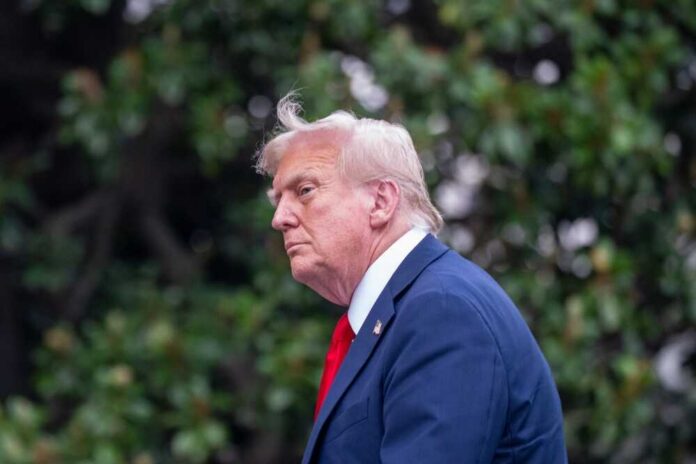
President Trump has tied the future of U.S. troops in Europe directly to whether America gets Greenland — turning a long-running territorial push into a major bargaining chip with NATO allies.
Story Snapshot
- Trump says whether U.S. troops stay in Europe will depend on the Greenland situation.
- At the World Economic Forum in January 2026, Trump argued the U.S. needs to own Greenland outright for national security — a lease won’t cut it.
- Trump threatened tariffs of up to 25% on European nations that refused to back his Greenland plan, then pulled back the threat after talks with NATO’s top leader.
- Denmark and Greenland have firmly rejected any sale, and several European nations sent troops to the island in a show of resistance.
Trump Links Troops to Greenland Deal
President Trump made clear that U.S. troop levels in Europe are not a separate issue from Greenland. Speaking at the World Economic Forum in Davos, Switzerland, in January 2026, Trump said America needs “right title and ownership” of Greenland — not just a lease — to properly defend it. He argued a lease does not give the U.S. the legal standing to protect the island. That framing puts European allies in a tight spot: no Greenland deal, no guarantee of U.S. troops.
Trump had already told a joint session of Congress in March 2025 that “one way or the other, we’re going to get” Greenland. That statement left little doubt about his intent. His push is rooted in Arctic strategy — Greenland sits at a critical crossroads for monitoring Russian and Chinese military activity, and it holds vast rare earth mineral deposits vital to U.S. defense technology.
Tariff Threats and a Diplomatic Pullback
To pressure allies, Trump threatened a 10% tariff on goods from Denmark, Sweden, France, the United Kingdom, the Netherlands, and Finland — with an escalation to 25% by June 1 if they refused to back his Greenland plan. The threat rattled European capitals. But after a meeting with North Atlantic Treaty Organization (NATO) Secretary General Mark Rutte at Davos, Trump described the talks as “very productive” and pulled back the tariff threats, saying a “framework” for a deal had been reached.
Rutte confirmed the troop withdrawal process would be gradual and “structured,” and said it would “not have an impact on NATO’s defense plans.” A U.S. general also stated no additional immediate withdrawals were planned and that any redeployment would take several years. Italian Prime Minister Giorgia Meloni added that her government had “not been informed of any formal withdrawal” of American forces. In short, the troop withdrawal threat — at least for now — appears to be leverage, not a done deal.
Europe Pushes Back Hard
European leaders have not taken the pressure quietly. Danish Prime Minister Mette Frederiksen declared “Europe won’t be blackmailed” and warned that Trump’s approach could tear apart the Atlantic alliance. She went further, saying if things went wrong, “everything collapses — including NATO.” Greenland’s Prime Minister Múte B. Egede also rejected any U.S. takeover under “any circumstances,” making clear the island’s people do not want to be absorbed by America.
France, Sweden, Germany, and Denmark all sent military personnel to Greenland for training and security — a direct signal of institutional resistance to U.S. claims. The European Union’s Commission President Ursula von der Leyen promised a response that would be “firm, united, and proportional.” Trump also appointed Louisiana Governor Jeff Landry as a special envoy to Greenland without telling Denmark or the State Department first — a move that caused backlash and deepened distrust among Greenlandic officials. The standoff is far from over, and the stakes — for NATO, Arctic security, and U.S.-European relations — couldn’t be higher.
Sources:
thegatewaypundit.com, bbc.com, cfr.org, youtube.com, npr.org, thearcticinstitute.org, newyorker.com