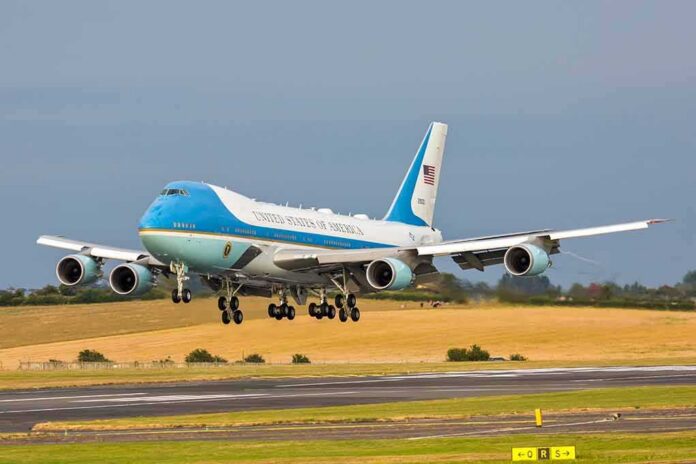
Boeing just booked another $280 million loss on the next Air Force One, saying it is spending more now to keep President Trump’s new jet on track for delivery in 2028.
Story Snapshot
- Boeing’s VC-25B Air Force One program took a fresh $280 million hit, lifting total losses to about $3 billion.
- The company says the money is going into extra production and certification work to protect the 2028 delivery schedule.
- The fixed-price deal, renegotiated under President Trump, means taxpayers avoid these overruns while Boeing absorbs the losses.
- Years of delays, supplier problems, and strict security and testing demands continue to pressure the program.
Boeing’s New $280 Million VC-25B Loss: What It Means
Boeing reported a new $280 million charge on its VC-25B program, the effort to build the next aircraft that will fly as Air Force One when President Trump is on board. The loss came in the company’s defense segment and pushed total VC-25B losses to roughly $3 billion, far above the original plan for the contract. Boeing said the new hit is mainly from “additional production and certification resources” aimed at strengthening the build and test effort as the jet moves toward flight trials.
Company president and chief executive officer Kelly Ortberg told investors the loss is “disappointing” but said Boeing “made the decision to add significant resources to support the build and test schedule on VC-25B.” He argued that investing more now should lower risks in certification and flight testing and help Boeing keep its pledge to deliver the first VC-25B in 2028. In its official release, Boeing stressed that schedule performance for this high-profile aircraft is critical to its government customer and that the firm is “investing accordingly.”
A Costly Fixed-Price Deal That Protects Taxpayers
The VC-25B work sits under a fixed-price contract first signed in 2018 after a public negotiation in which President Trump pushed aggressively for lower costs and fewer extras on the new Air Force One. Under this deal, Boeing must cover any cost overruns itself instead of passing them on to taxpayers, which is why the company keeps recording large “reach-forward” losses when expenses rise. Earlier charges of $318 million linked to coronavirus disruptions and a troubled interior supplier, plus $660 million and $482 million losses tied to manufacturing costs and labor issues, had already driven total program losses into the billions before this latest quarter.
Because the price is locked, the widening gap between Boeing’s actual costs and what it can bill the government shows how hard it is to manage such a complex, secure aircraft under tight financial limits. For conservative readers, there is a key point: despite the headlines about “overruns,” the fixed-price structure means the federal government is not paying these extra billions. Instead, the contractor is absorbing them on its own books, a model many budget hawks prefer for highly visible projects where discipline and accountability matter most.
Years of Delays, Supplier Trouble, and Security Demands
The new charge lands on a program already hit by years of delay. The original plan called for the first VC-25B to be delivered around late 2024, but the date has slipped several times as Boeing and the U.S. Air Force confronted supply chain problems, workforce shortages, design changes, and demanding security and communications upgrades for the presidential mission. Government reports and press coverage now point to mid-2028 for the first delivery, with the second jet expected afterward, roughly four years later than first promised.
Part of the trouble traces back to the interior supplier GDC Technics, which Boeing fired in 2021 for being late, sparking legal disputes and adding at least two years to the schedule. At the same time, coronavirus rules and security clearance limits made it harder to move mechanics in and out of the project, slowing hands-on work inside the aircraft. Engineers also had to refine wiring, environmental systems, and hardened communications that allow the president to command military forces from the sky, all of which raise the bar on testing and certification.
Why Boeing Is Spending More Now to Hold the 2028 Date
Ortberg and his team say the latest $280 million is not about giving up on the schedule but about spending more today to avoid worse problems tomorrow. Boeing is adding people and tools on the production line, boosting certification staff, and shifting from a civilian to a military certification basis agreed with the Air Force, all meant to smooth the path into flight testing. The company argues that these steps “help mitigate potential risks” as the jet moves from the factory floor into the air, where any failure or delay would be under intense public and political scrutiny.
Boeing Has Now Eaten $3B In Air Force One Cost Overruns
Boeing says it is once again paying out of pocket to ensure the first fully-equipped VC-25B jet is finally delivered in 2028, many years late.https://t.co/eVpmUBEfEM
— Tyler Rogoway (@Aviation_Intel) July 28, 2026
For President Trump’s administration and for Americans who care about strong national leadership, the stakes are clear. The next Air Force One must be safe, secure, and ready on time, but it also must respect taxpayers and avoid the bloated, open-ended spending that marked past defense projects. Here, a Trump-era fixed-price bargain is forcing Boeing to tighten its belt and fix problems on its own dime, even as it invests more to hit the 2028 goal and deliver a reliable aircraft to serve the commander in chief.
Sources:
insidedefense.com, breakingdefense.com, airandspaceforces.com, techtimes.com, stripes.com, flightglobal.com, en.wikipedia.org, expressnews.com, twz.com, defenseone.com, facebook.com, reuters.com