

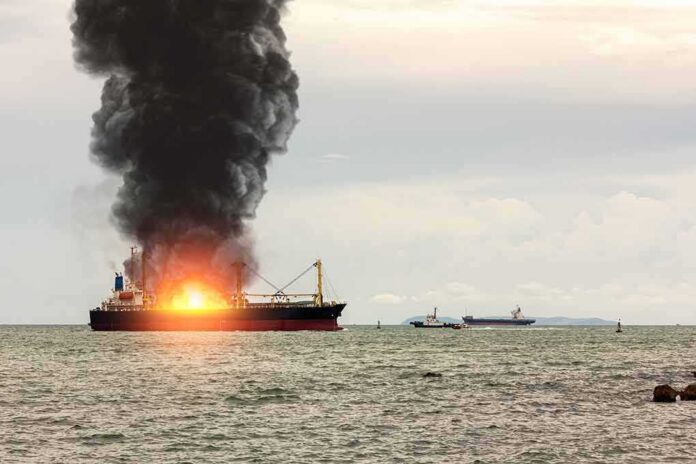
Two merchant ships were struck by sea and air drones in Bulgaria’s Black Sea zone, sinking one and igniting the other, officials said.
Story Highlights
- Bulgaria’s prime minister confirmed two ships were hit by drones around 3 a.m. local time.
- One vessel reportedly sank; another caught fire and its crew was rescued by a Bulgarian ferry.
- The attack occurred about 70 nautical miles east of Byala, inside Bulgaria’s exclusive economic zone.
- Officials called the strike a blatant breach of international and maritime law.
Confirmed Strike Location and Timeline
Prime Minister Rumen Radev said drones hit two merchant ships at around 3:00 a.m. local time. He placed the incident about 70 nautical miles east of the coastal town of Byala, inside Bulgaria’s exclusive economic zone. That location matters because it is not territorial waters but remains an area where Bulgaria holds key economic rights. His office framed the event as a national security issue and triggered an emergency government meeting to coordinate response efforts.
Reports identified two foreign-flagged vessels as the targets. The Togo-flagged Alfa Watan reportedly sank after the strike. A Palau-flagged ship, named Able or Abel in different reports, caught fire. Bulgarian and international outlets described a rapid rescue effort at sea. One account said the crew of the second vessel was evacuated by a Bulgarian ferry after the blast and fire. Officials acknowledged that crew accounting from the sunken vessel remained in flux in early updates.
Casualties, Rescue, and Vessel Status
Bulgarian and wire reports described urgent search-and-rescue in choppy conditions. Coverage said the crew of the burning ship was pulled to safety, with some injuries reported. The picture for the sunken vessel was less certain in the first hours, with searches ongoing and mixed early counts. Such variance is common in fast-moving maritime incidents, and authorities often refine numbers as they verify with rescuers, hospitals, and ship operators on shore.
Radev condemned the strikes as an absolutely unacceptable attack and a blatant violation of international and maritime law. His language signaled that Sofia views the strike as more than a shipping incident. It is a challenge to navigation rights in a busy corridor that carries grain, fuel, and goods linking Europe and global markets. Bulgarian National Radio and other national outlets echoed the timing, location, and core outcomes as officials coordinated next steps.
Drones and a Risky Black Sea Pattern
Officials said sea drones and aerial drones were used in the attack. That detail fits a larger Black Sea trend since 2022, where unmanned systems have become cheaper and more common tools to hit civilian shipping and port links. State media and national outlets in Bulgaria carried consistent reports on the drone use and the rescue push east of Byala. Maritime insurers and shippers now factor these threats into routes, speed choices, and crew drills across the region.
Drone Attack Hits Ships Near Bulgaria
Two merchant ships were attacked by air and sea drones in Bulgaria’s Black Sea economic zone on October 6. One sank and its crew remains missing; 18 crew members from the other ship were rescued. The attackers have not been confirmed.
— WITNESS Global (@witnessanalysis) October 7, 2026
This strike pushes danger closer to North Atlantic Treaty Organization waters and trade lines that feed Europe and the United States. American families feel shocks from events like this through energy prices and supply costs. President Trump’s team has prioritized strong deterrence and secure trade lanes. Incidents like this underscore why steady naval presence, rapid intelligence sharing, and rules that punish attacks on civilian ships are vital to keep markets steady and families protected.
Sources:
euronews.com, abcnews.com, bnrnews.bg, bntnews.bg, bbc.co.uk, turkiyetoday.com, nova.bg