
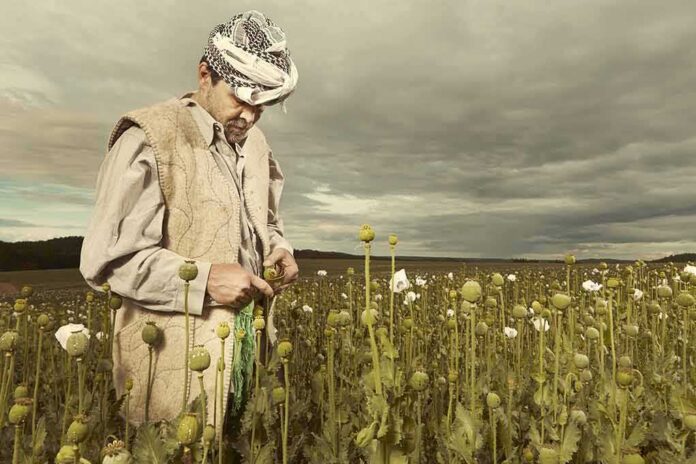
A United Nations survey shows Afghanistan’s poppy fields collapsed after a Taliban ban, then rebounded as hungry farmers returned to opium to feed their families.
Story Snapshot
- Afghan poppy cultivation fell about 95 percent in 2023 after a nationwide Taliban ban.
- United Nations officials report a 2024 rise in planting, still far below 2022 levels.
- Farmers cite drought, lost income, and weak alternatives for returning to poppy.
- The shift raises border, cartel, and addiction risks that can spill into the United States.
What the United Nations Data Shows About the Ban
The United Nations Office on Drugs and Crime reported that Afghanistan’s opium poppy cultivation fell from an estimated 233,000 hectares in 2022 to about 10,800 hectares in 2023, a drop near 95 percent after the Taliban issued a national ban in April 2022. United Nations reporting said the decline stretched across the country and drove opium output down from roughly 6,200 tons in 2022 to about 333 tons in 2023. Those numbers marked one of the sharpest recorded reductions worldwide.
United Nations analysts said 2024 brought a rebound. Cultivation grew by about 19 percent to roughly 12,800 hectares, led by gains in the northeast, yet it remained far below the 2022 baseline. The agency also estimated that farmer income from the 2023 harvest fell more than 92 percent, from about $1.36 billion in 2022 to $110 million in 2023, pushing many households toward poverty. These data points confirm a crash in supply, followed by partial return under economic strain.
Why Farmers Are Returning to Poppy
United Nations coverage and wire reports say many Afghan families lack realistic options to replace opium income. Farmers described wheat that barely covers costs, drought that ruins cotton and grains, and briny well water that harms crops, all while food prices rise. A United Nations statement linked the 2024 increase to hardship and to the lack of real alternative livelihoods that can feed families. This mix of weak markets, water stress, and limited aid makes poppy the only crop that pays for many.
Experts noted that cultivation also shifted locations. United Nations reporting said most 2024 planting clustered in northeastern provinces, showing displacement rather than a clean end to the drug economy. That pattern matters for policy because it signals networks are adapting, not vanishing. The data set does not include a full province-by-province causal breakdown, so it cannot weigh exactly how much of the fall came from enforcement versus drought or market forces. The bottom line is clear: pain rose, then supply began to creep back.
What This Means for U.S. Security and Policy
Drug flows do not stop at borders. When opium production falls fast in one area, criminal groups look for gaps, new routes, or new suppliers. United Nations officials warned that a quick drop, without stable farm income, is hard to sustain. For Americans, that risk echoes lessons from past drug wars. Supply squeezes can shift crime into other regions or into synthetics that are even deadlier. That is why strong borders and tough trafficking enforcement are nonnegotiable priorities.
Conservative readers know what works at home: secure the border, crush cartels, and reject policies that fuel dependency and chaos. The United States should press partners to target labs, money men, and cross-border smugglers, while keeping pressure on any regime that lets narco-networks thrive. At the same time, support that helps farmers grow legal crops can stop the bounce-back we see in Afghanistan. Enforcement without exit ramps invites relapse; real alternatives close the door.
Sources:
youtube.com, unodc.org, news.un.org, unis.unvienna.org, today.rtl.lu