
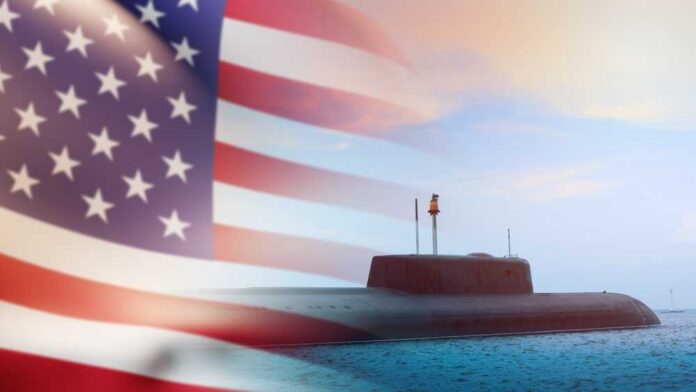
America’s Navy has only three of the world’s most advanced attack submarines while rivals mass-produce undersea weapons, leaving a strategic vulnerability that defense planners say cannot be fixed.
Quick Take
- The U.S. Navy terminated the Seawolf-class submarine program after building just three hulls instead of the planned 29, creating an irreversible capacity gap at a critical moment in great-power competition.
- Attack submarine inventory is projected to plummet into the low 40s by the early 2030s, far below the Navy’s benchmark of 66 boats, leaving American forces stretched dangerously thin across the Pacific.
- The submarine industrial base is understaffed by approximately 25 percent, preventing rapid production increases and leaving critical maintenance backlogs that keep operational boats in dry dock longer than necessary.
- China’s expanding naval forces and Russia’s advanced submarines now operate in a strategic environment where the U.S. undersea advantage—once overwhelming—has eroded to a precarious position.
The Decision That Cannot Be Undone
In the 1990s, following the Soviet Union’s collapse, Pentagon planners faced a choice: continue building expensive Seawolf-class submarines designed for high-end Cold War conflict, or pivot to cheaper, more flexible Virginia-class boats optimized for post-Cold War operations. Cost won. The Navy built three Seawolfs at roughly $3 billion each, then terminated the program entirely. That decision, made three decades ago, now haunts military strategists as China expands its naval forces and Russia deploys advanced submarines across contested waters.
From 29 Submarines to Three
The original Seawolf program envisioned approximately 29 attack submarines that would dominate undersea warfare for decades. Instead, only USS Seawolf, USS Connecticut, and USS Jimmy Carter were completed. These three represent the Navy’s most capable attack submarines—apex predators engineered for high-end undersea combat. Yet three submarines cannot perform the missions of 29. They cannot be simultaneously protecting carrier strike groups, conducting intelligence patrols, and deterring adversaries across multiple ocean regions.
The Retirement Wave Accelerates the Crisis
The Seawolf decision created a cascading problem. The older Los Angeles-class submarines it was supposed to replace continued aging out of service. By the end of 2023, well over half of the original 62 Los Angeles-class boats had been retired, with more decommissionings scheduled. The Navy needed replacement submarines urgently, but the industrial base could not produce Virginia-class boats fast enough to fill the gap. Virginia-class construction has struggled to meet even two boats per year, the Navy’s aspiration. This structural mismatch between retirements and new construction is now creating what planners call a “submarine trough”—a period of acute shortage beginning in the late 2020s.
The Operational Crunch of 2026
The crisis is no longer theoretical. USS Connecticut, one of only three Seawolf-class submarines, remains out of service until at least late 2026 following a collision with an uncharted seamount near Japan on October 2, 2021. The five-year repair timeline reflects the complexity of maintaining rare Seawolf-class vessels and the limited industrial capacity available. Simultaneously, USS Seawolf is entering extended maintenance in 2026, potentially leaving only USS Jimmy Carter—which is not optimized for traditional attack missions—operationally available for critical periods. At certain points, the Navy may have only one Seawolf-class submarine at sea.
The Numbers Tell a Grim Story
The Navy has maintained a benchmark of 66 attack submarines as the minimum force structure needed for global commitments. Official analyses now project inventory dipping into the low 40s during the late 2020s and early 2030s. That represents a reduction of approximately 40 percent from the stated requirement. The gap persists because the next-generation SSN(X) submarine program is not expected to enter production until the early 2040s—leaving roughly 15 years of insufficient undersea capacity precisely when great-power competition with China and Russia demands maximum capability.
Industrial Base Collapse Prevents Recovery
Even if the Navy wanted to surge submarine production immediately, it cannot. The submarine industrial base is understaffed by approximately 25 percent—roughly a quarter of the workforce needed to meet both construction and maintenance demands. This is a structural problem, not a temporary bottleneck. Submarine workers require years of specialized training. Shipyard facilities take years to expand. Supply chains cannot be rapidly reconstituted. The result is a situation where strategic necessity exceeds available resources and production capacity.
Strategic Advantage Shifts to Competitors
The shortage directly benefits Russia and China. China’s mass production of naval forces is now exacerbating the effects of the U.S. submarine shortage, forcing the Navy to stretch its finite fleet across an expanding Pacific that shows no signs of shrinking. A fleet of even 10 to 12 additional Seawolf-class submarines would dramatically alter the Navy’s strategic options, particularly in the Indo-Pacific, where maintaining sea denial against Chinese expansion has become a core strategic requirement. Instead, American planners must work with three.
A Mistake That Defines an Era
Defense analysts and Navy leadership acknowledge the reality plainly: the termination of the Seawolf program was a strategic error with consequences that cannot be reversed. The submarines that were not built in the 1990s cannot be built retroactively in the 2020s. The industrial base that was allowed to shrink cannot be rapidly rebuilt. The 15-year gap in next-generation submarine production cannot be closed. What remains is a Navy attempting to manage an acute undersea shortage during the most competitive great-power environment since the Cold War ended—a challenge that grows more urgent with each passing year.
Sources:
The U.S. Navy’s Stealth Seawolf-Class Submarine Shortage Is Extremely Dangerous
The U.S. Navy Is Missing 26 Seawolf-Class Nuclear Attack Submarines
US Navy Submarine Will Be Out 5 Years Due to ‘Poor Seamanship’
Undersea Gap: Why the U.S. Navy Can’t Build Its Way Out of a Submarine Crisis