
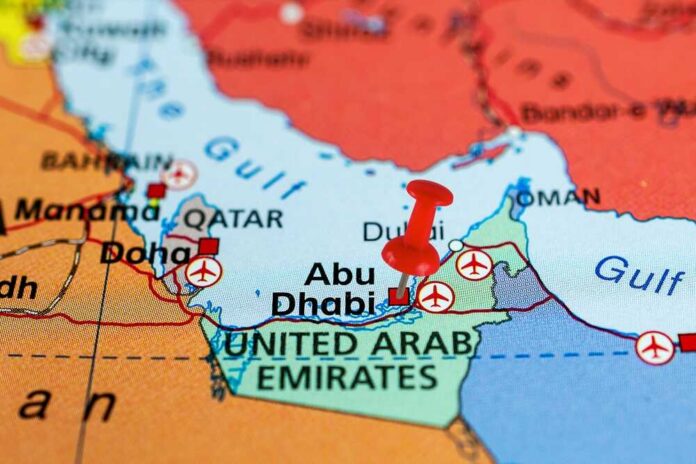
A drone-triggered fire near key Emirati energy assets underscores how cheaply made weapons can endanger global fuel supplies and test U.S. allies’ defenses.
Story Snapshot
- Authorities in the United Arab Emirates reported a fire at Adnoc’s Ruwais complex after a drone-related incident, with no injuries initially reported [3].
- Regional coverage says debris from an interception struck the Borouge petrochemical site, prompting an emergency shutdown [2].
- United Arab Emirates officials said air defenses have intercepted thousands of threats during the broader campaign, including drones launched from Iran [4].
- The United Arab Emirates condemned the attacks as targeting civilian sites and violating international law [5].
What Officials Confirmed About the Abu Dhabi Energy-Site Fire
Authorities in the United Arab Emirates said a fire broke out at a facility within Adnoc’s Ruwais refinery complex after a drone attack, and that emergency crews contained the blaze with no injuries reported at the time of the statement [3]. Reporting describes the incident as part of an ongoing pattern of strikes on Gulf energy infrastructure, which has included facilities in Bahrain, Kuwait, and Saudi Arabia in recent days [3]. Officials indicated that damage assessments were underway to determine operational impacts [3].
Regional broadcasts amplified details that falling debris from an interception struck the adjacent Borouge petrochemical plant, triggering fires and an immediate pause in operations as emergency protocols activated [2]. These accounts align with a scenario where air-defense engagement prevented a direct hit but still caused secondary damage on the ground. While such reports illuminate the incident’s sequence, they rely on video narration rather than a released technical report from the United Arab Emirates government or facility operators [2].
Air Defenses, Interceptions, and the Campaign Context
Coverage citing the United Arab Emirates government stated that air defenses intercepted two drones launched from Iran and, across the broader campaign, claimed more than two thousand drones, along with dozens of ballistic and cruise missiles, have been intercepted since hostilities escalated [4]. The United Arab Emirates Foreign Ministry publicly framed the strikes as treacherous terrorist attacks targeting civilian sites and warned that the actions represent a dangerous escalation in violation of international law and the United Nations Charter [5]. These official statements reinforce the hostile-act narrative.
Energy-market reporting placed the Ruwais complex fire within a sequence of regional strikes that have targeted refineries and terminals across the Gulf, highlighting a deliberate pressure campaign against critical infrastructure [3]. This pattern raises stakes for global energy prices and supply stability. For American readers, the risk is clear: disruptions at major Gulf facilities translate into price spikes at home, complicating family budgets already stretched by years of inflation and high energy costs. The episode shows why reliable borders, strong deterrence, and resilient supply chains matter.
What We Know, What We Do Not, and Why It Matters to U.S. Households
The available record confirms a fire at an Adnoc site following a drone incident, an emergency response, and a sovereign-state denunciation of attacks on civilian targets [3][5]. However, the materials supplied do not include a published forensic attribution for the Abu Dhabi facility specifically, and open-source reporting varies on whether the affected site was an unidentified unit at Ruwais or the Borouge petrochemical plant [2][3]. Without debris analysis or official operator disclosures, the precise ignition point and damage extent remain publicly unresolved.
That uncertainty is typical early in Gulf security incidents, but the practical effect is the same for consumers: every attack or debris impact near oil and petrochemical hubs adds risk premiums to fuel and shipping. America’s economic stability depends on secure energy flows and credible deterrence. The United States can support allies’ defenses while prioritizing domestic production, pipeline capacity, and refinery upgrades to blunt price shocks—commonsense steps that respect national sovereignty and protect working families from avoidable energy volatility.
Policy Signals for Conservatives: Deterrence, Transparency, and Energy Security
United Arab Emirates statements about extensive interceptions show defenses are active, but secondary damage from falling debris still carries real costs [2][4]. Conservative readers should watch three items: first, whether the United Arab Emirates publishes a facility-level incident report naming the affected unit and downtime; second, whether debris forensics identify a specific platform and launch vector; third, whether allied coordination hardens energy nodes against both direct hits and interception fallout. Clear evidence and hardened defenses deter future strikes without inviting broader escalation.
For U.S. policymakers, the lesson is to pair strong border and homeland security with a drill-more, build-more energy agenda that reduces reliance on fragile chokepoints. Sensible steps include accelerating permits for domestic refining modernization, streamlining approvals for liquid natural gas export capacity to steady allies, and reinforcing missile and drone defenses around critical overseas terminals. When America leads with energy abundance and unapologetic security, families see steadier prices, and adversaries think twice before probing the world’s fuel lifelines.
Sources:
[2] YouTube – Huge Fire In Abu Dhabi As Cruise Missiles Strike Saudi Arabia
[3] Web – Drone attack causes fire at Adnoc’s Ruwais complex – Argus Media
[4] YouTube – Abu Dhabi Claims 2200+ UAVs DESTROYED Since The Start Of War
[5] Web – Major fire erupts at UAE oil facility after drone strike from Iran