

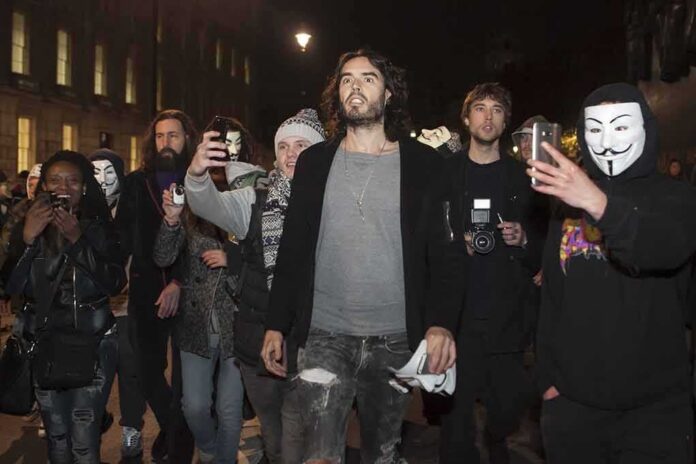
Russell Brand’s rape and sexual assault trial opened in London, launching a high-stakes test of evidence that spans a decade of alleged crimes.
Story Snapshot
- Prosecutors say six women accuse Brand of offences from 1999 to 2009.
- The Crown Prosecution Service authorised multiple serious charges after police investigation.
- Brand pleaded not guilty and arrived at Southwark Crown Court as the trial began.
- The case highlights how historic sex cases pose complex proof challenges in the United Kingdom.
Trial Opens at Southwark Crown Court
London’s Southwark Crown Court began hearing the criminal case against comedian and actor Russell Brand. Prosecutors charged Brand with counts that include rape, oral rape, sexual assault, and indecent assault tied to alleged incidents from 1999 to 2009. Reporters on scene confirmed his arrival for the start of proceedings and the formal launch of the trial calendar. Brand denies all charges. The court will hear evidence from multiple women as the judge and jury weigh testimony, timing, and corroboration against the defence case.
Prosecutors say the charges grew out of a police investigation into non-recent offences. The Metropolitan Police provided a file to the Crown Prosecution Service, which then authorised charges after reviewing the material. The Crown Prosecution Service announced its decision to proceed in a public statement, citing alleged conduct across several years and involving several complainants. That step moved the case from inquiry to courtroom, where rules of evidence and cross-examination now control what the jury may consider in reaching a verdict.
What Charges Mean and How the Case Will Be Tried
The charges allege separate criminal acts and will be proven, or not, through specific evidence. Jurors will hear from complainants, view any admissible records, and consider defence challenges on credibility and memory. Courts in the United Kingdom try serious offences before a jury, with the judge instructing on law and burden of proof. Brand has pleaded not guilty, which means prosecutors must prove each charge beyond a reasonable doubt. The judge will also guide jurors on how to handle historic allegations and potential gaps in physical evidence.
Historic cases like this often rely heavily on testimony and any contemporaneous records that survive. Courts will test consistency across statements, timelines, and known events. Defence lawyers may question recall, motive, or delay. Prosecutors may point to patterns, corroboration, or trusted disclosures. This method aims to protect the presumption of innocence and the rights of accusers to be heard. The process is deliberate and often slow, but it is designed to reach a fair judgment under settled legal standards in the United Kingdom.
Why This Case Draws Wide Attention
This trial draws attention because it involves a high-profile figure and long-delayed allegations. Public interest also follows broader data showing how few rape cases in England and Wales move from report to charge and conviction. Government and justice reports have tracked these trends and the uphill challenge they pose for both accusers and defendants. The numbers frame the stakes: each case that reaches court faces intense scrutiny of facts and process to ensure justice in individual circumstances.
Parliamentary and justice statistics show mixed signals: referrals and prosecutions have shifted over recent years, and conviction rates move within a tight band. These figures do not decide any single case, but they do explain why a historic prosecution can look rare and important at the same time. The court, however, will judge only the charges against Brand. Jurors will be told to ignore outside noise and focus on legal instructions and the evidence presented in that courtroom alone.
Constitutional and Cultural Lens for U.S. Readers
American readers value due process, the presumption of innocence, and equal justice under law. Those values matter here, even though this is a United Kingdom trial. Brand’s case will rise or fall on evidence tested in court, not on media takes or online mobs. Conservatives have seen reputations tried on social media first and in court later. The right answer is the rule of law: protect victims, guard defendants’ rights, and let facts decide. That is the standard we expect at home and abroad.
Comedian Russell Brand is in London for a trial where he is facing charges of rape and sexual assault. The case is expected to last 10-12 weeks. https://t.co/2VM5Od7NBa
— WKYC 3News (@wkyc) October 13, 2026
Families who watched institutions bend to trends should watch this case with a clear eye. The claims are serious. The denials are firm. The process must be clean. That means no rush to judgment, no gagging of speech, and no special treatment. If the evidence proves guilt, the jury will say so. If the state falls short, the jury must acquit. That is justice. It is how a free society defends both safety and liberty, even in the most charged cases.
Sources:
youtube.com, variety.com, cps.gov.uk, straitstimes.com, bbc.com, lbc.co.uk, itv.com, standard.co.uk