

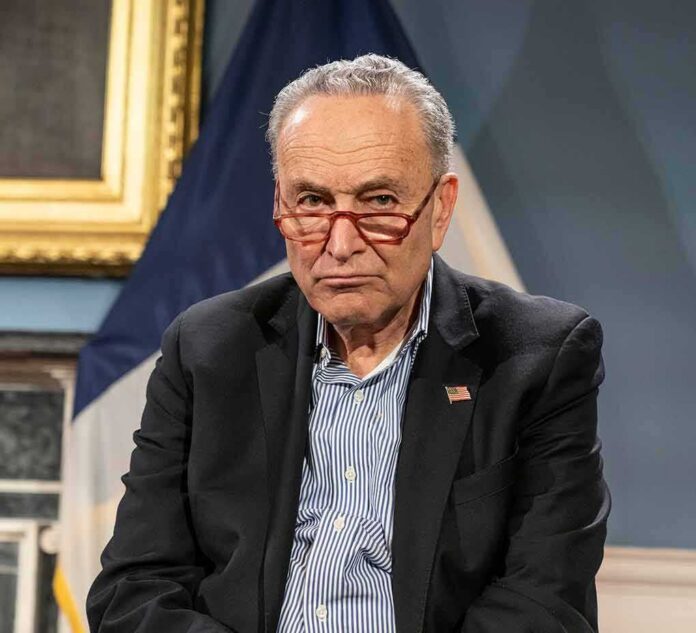
Bernie Sanders says he will not support Chuck Schumer for Senate Democratic leader, putting a public crack in Democrats’ post-election unity.
Story Highlights
- Bernie Sanders refused to back Chuck Schumer for Democratic leader.
- Multiple Democratic senators and senators-elect urged new leadership or withheld support.
- Chris Van Hollen asked colleagues to delay commitments until Schumer offers a clear plan.
- Secret-ballot rules mean real opposition could be larger than public statements suggest.
Sanders Breaks With Schumer as Dissent Spreads
Bernie Sanders said he will not support Chuck Schumer for Senate Democratic leader, adding high-profile weight to a growing list of Democrats pressing for change. Reporting shows several Democrats, including incoming members, called for new leadership or refused to endorse Schumer after the elections. Representative Elissa Slotkin, now senator-elect, would not commit and said any leader must lay out a first 100 days plan before earning her vote. The push signals internal unrest despite Democrats’ recent electoral gains.
Senator Chris Van Hollen urged colleagues to hold off on backing Schumer until he presents a governing vision, and he described himself as in “listening mode” on a possible bid. Several incoming Democrats, named in national reports, said the party needs fresh leadership and direction after years of the same faces at the top. While some critics stopped short of promising a “no” vote, their public stance puts pressure on Schumer to show a concrete plan that addresses costs, border security, and accountability.
Calls for a Concrete Agenda and First 100 Days Plan
Elissa Slotkin tied her support to whether any candidate, including Schumer, can lay out a clear first 100 days agenda that tackles key priorities. Van Hollen echoed the need for a defined vision before senators commit their votes. For conservatives watching the Senate, the demand for a real plan should sound familiar. Voters want action on runaway spending, energy policy that lowers bills, and securing the border. Democrats now must explain how their plan will fix the problems their own policies helped create.
Democratic leaders frame their win as a mandate and argue continuity is the best way to deliver. The New York Times reported Schumer’s team credits a $550 million effort and candidate recruiting with flipping the chamber and says he has enough commitments to remain leader. That claim, however, runs into public resistance from new voices who say a mandate without a roadmap is not a plan. The split shows the tension between machine politics and members who want policy change, not just campaign war chests.
Secret-Ballot Reality: What the Public Cannot See
Senate party leadership elections use secret ballots, which hide individual votes from the public and even many colleagues. That process lets senators signal one thing in public and vote another behind closed doors. Reports note the upcoming vote requires only a simple majority, and private tallies, not press quotes, decide the outcome. For readers, this means the number of Democrats breaking with Schumer could be larger than what is said on camera, and final results may surprise both sides.
At the same time, no formal challenger has locked in. Outlets report Schumer remains the favorite unless a viable opponent steps up with real votes. Van Hollen has not declared, and Slotkin has not launched a bid. That leaves the dissent without a rally point, even as its policy demands gain air time. Without an organized alternative, momentum can fade. With one, the secret ballot could quickly turn a few loud doubts into a new leadership slate.
Why This Matters to Conservative Readers
Democrats’ leadership fight affects every kitchen-table issue. Senate leaders control what bills get a vote, how much is spent, and whether the border is secured. Schumer’s critics say they want a clear plan for the first 100 days. That test is simple: Will Democrats cut spending, lower energy costs by unleashing American production, and respect constitutional rights? If the answer is more central control, more red tape, and soft-on-border policies, families will pay the price again.
Bernie Sanders Breaks With Chuck Schumer, Refusing to Endorse Longtime Leader as Senate Democratic Revolt Expands
• Senator Bernie Sanders publicly announced he will not…
• Joined by Senator Elissa Slotkin and incoming lawmakers…#BernieSanders https://t.co/plBHCjvblQ…— Newstro (@Newstro) November 11, 2026
President Trump’s team is pressing an agenda of secure borders, cheaper energy, and leaner government. A divided Democratic caucus could stall or water down those goals. But a caucus that rallies around old leadership may double down on the same policies that drove inflation, caused high energy bills, and ignored chaos at the border. Watch for three tells: whether Democrats publish a detailed 100-day plan, whether a serious challenger emerges, and how many members hide behind the secret ballot instead of owning their vote.
Sources:
townhall.com, nytimes.com, nwaonline.com, democrats.senate.gov, nbcnews.com