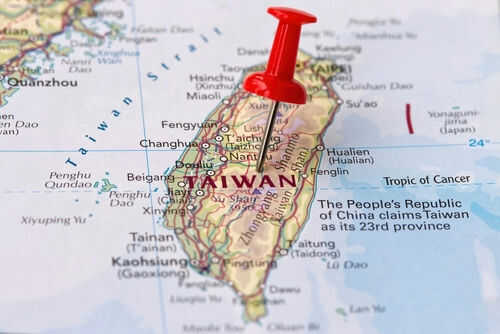
Despite alarming claims that America’s aircraft carriers would be sitting ducks in a Taiwan conflict, the U.S. Navy maintains multiple carrier strike groups actively operating in the Western Pacific right now—exposing a dangerous gap between media hysteria and military reality that could mislead citizens about our nation’s actual defense posture.
Story Snapshot
- U.S. Navy currently operates 11 aircraft carriers with 2-3 routinely deployed in the Western Pacific, directly contradicting claims of “no carriers” available for a Taiwan conflict
- China’s advanced “carrier killer” missiles and anti-access weapons force American carriers to operate from standoff distances beyond 1,000 miles, fundamentally changing tactics since the 1996 Taiwan Strait Crisis
- Recent U.S. deployments include USS Abraham Lincoln and USS George Washington conducting operations near Taiwan as China rehearses blockade scenarios through military drills
- War simulations predict America would prevail in a Taiwan conflict but at devastating cost, potentially losing 2-5 aircraft carriers to China’s missile arsenal
The Misleading Narrative Behind Carrier Availability
The claim that America lacks aircraft carriers for a Taiwan war stems from misunderstanding operational constraints, not actual fleet numbers. The U.S. Navy maintains 11 nuclear-powered aircraft carriers, the world’s largest fleet, with multiple vessels routinely stationed in the Indo-Pacific region. As of early 2026, the USS Abraham Lincoln operates in the South China Sea and Philippine Sea equipped with F-35C stealth fighters, while USS George Washington is based at Yokosuka, Japan. The amphibious assault ship USS Tripoli, carrying F-35B fighters, further reinforces American presence in the East China Sea. This represents substantial naval power projection capability, not absence.
China’s Missile Threat Reshapes Carrier Tactics
What has genuinely changed is how carriers operate in contested waters. China’s decades-long development of anti-access/area-denial systems, particularly the DF-21D and DF-26 anti-ship ballistic missiles dubbed “carrier killers,” forces American carriers to maintain standoff distances exceeding 1,000 miles from potential conflict zones. This contrasts sharply with the 1996 Taiwan Strait Crisis, when U.S. carrier strike groups demonstrated dominance by positioning near Taiwan without Chinese capability to effectively challenge them. That crisis humiliated Beijing and sparked China’s obsession with developing weapons specifically designed to neutralize America’s carrier advantage through integrated missile systems, submarines, and over-the-horizon radar networks.
The tactical reality demonstrates prudent adaptation rather than weakness. No U.S. aircraft carrier has transited the Taiwan Strait itself since 1996, though smaller surface vessels continue regular freedom of navigation operations. American carriers now operate from peripheral positions in the Philippine Sea and broader Pacific, launching aircraft and coordinating with submarines and allied forces rather than sailing directly into China’s defensive umbrella. This distributed lethality approach acknowledges the threat environment without conceding strategic position or abandoning Taiwan’s defense under the Taiwan Relations Act of 1979.
War Games Reveal Sobering Costs of Conflict
Independent simulations, including comprehensive war games conducted by the Center for Strategic and International Studies, consistently predict American victory in a Taiwan conflict but at catastrophic cost. These scenarios forecast potential losses of two to five aircraft carriers, each representing approximately thirteen billion dollars in sustained investment and housing over 5,000 personnel. The simulations underscore that carriers remain relevant and deployable, but face unprecedented risks from China’s layered defenses combining ballistic missiles, cruise missiles, hypersonic weapons, diesel-electric submarines, and sophisticated sensor networks. Such losses would dwarf any naval combat casualties since World War II and fundamentally challenge America’s post-war naval supremacy.
Current Deployments Counter Alarmist Claims
Recent operations directly refute the “no carriers available” narrative. Throughout late 2025 and early 2026, as China conducted provocative “Justice Mission 2025” drills simulating Taiwan blockades, multiple American carriers maintained persistent presence. The USS Abraham Lincoln deployed from San Diego through Guam to forward positions in the South China Sea and Philippine Sea, while USS George Washington remained pierside in Japan ready for rapid deployment. The State Department issued statements in December 2025 demanding China “cease military pressure against Taiwan,” backed by visible naval power that signals American resolve despite the risks. This demonstrates Washington’s willingness to position high-value assets within potential combat zones when strategic interests demand.
The U.S. Navy Has No Aircraft Carriers for a China War over Taiwanhttps://t.co/EjuH4Px0Ef
— 19FortyFive (@19_forty_five) April 17, 2026
The genuine concern for Americans should focus on whether our government is being straight about the actual risks and costs of defending Taiwan. War games suggest potential losses that would shock the public, yet political leaders on both sides continue ambiguous commitments under “strategic ambiguity” that may not match public expectations. The deeper issue isn’t carrier availability but whether the Deep State and defense establishment are leveling with citizens about what a Taiwan conflict would actually cost in American lives and treasure—while China continues building capabilities specifically designed to exploit our most expensive military assets. Americans deserve clarity on whether carriers remain our best defense investment or increasingly vulnerable symbols of past dominance.
Sources:
No Strait Aircraft Carriers – CIMSEC
China Obsessed Sinking America’s Aircraft Carriers – The National Interest
US Sends A Warning Message To China – Pacific Island Times