

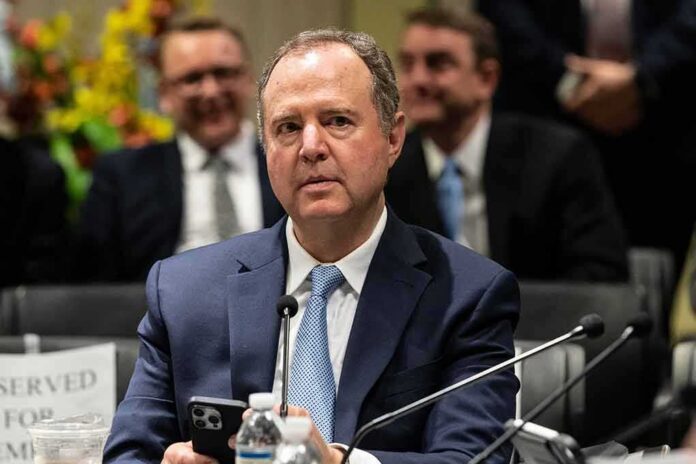
A Texas federal prosecutor just warned Adam Schiff that Congress is not a weapon to punish Americans for supporting President Trump — and he put it in writing.
Story Snapshot
- Texas U.S. attorney Aaron Reitz accused Senator Adam Schiff of “weaponizing Congress” tied to past Russia-collusion claims.
- Reitz sent a preservation letter over probes into private donors to President Trump’s proposed White House ballroom.
- The dispute centers on First Amendment rights to associate without being targeted by senators.
- Legal experts aligned with Democrats called Reitz’s letters “meritless,” underscoring a sharp partisan clash.
Reitz’s Charge: Congress Is Not A Punishment Tool
Texas U.S. attorney Aaron Reitz publicly accused Senator Adam Schiff of weaponizing Congress, linking it to Schiff’s Russia-collusion push. Reitz wrote that Americans have a First Amendment right to associate with the President without being targeted by senators, and said spiteful senators cannot “weaponize Congress.” His remarks directly invoked the “Russia collusion hoax” to argue Schiff had crossed a line in prior years, sharpening a long-running fight over partisan investigations.
Reitz’s accusation arrived alongside a formal step that raised the stakes. On November 11, he sent a letter demanding preservation of records tied to Senate inquiries into private donors to President Trump’s proposed White House ballroom. He argued that congressional probes must serve a real legislative purpose, not punish people for who they support. That demand put the First Amendment and limits on congressional oversight at the center of the clash.
What The Documents And Records Show So Far
The strongest document is Reitz’s own record-demand letter, which names Senator Richard Blumenthal’s investigation into Trump-ballroom donors, and outlines the claim of associational targeting. That gives the dispute a concrete paper trail, not just rhetoric. At the same time, the letter is not to Schiff. The available record does not cite a completed case, sworn testimony, or court judgment proving Schiff personally used federal power unlawfully. Those gaps narrow the claim’s legal footing.
Reitz’s appointment background is also part of the story. Judges in the Southern District of Texas appointed him as U.S. attorney, bypassing normal Senate confirmation. Critics say that makes his intervention less accountable. Supporters see a prosecutor willing to stand up for free association and push back on partisan fishing expeditions. The appointment order confirms the unusual route and gives opponents another line of attack on his motives rather than his arguments.
Schiff’s Investigative Record And The First Amendment Clash
Senator Schiff’s public actions show aggressive oversight on Trump-related matters. Schiff pressed Special Counsel Jack Smith on classified documents at Mar-a-Lago and pushed to subpoena the unreleased second volume of Smith’s report. Those moves show a leading role in probes with high political impact, though they do not by themselves prove unlawful “weaponization.” They do explain why conservatives see a pattern that chills speech and punishes association with the President.
Democracy Docket highlighted legal experts who called Reitz’s threats “meritless.” That view frames his letters as attempts to chill Senate speech. The sharp split reflects a recurring fight in Washington: sponsors call it oversight, targets call it punishment. The Supreme Court gives Congress wide room to investigate, but it still must have a real legislative purpose. That is the line Reitz says senators crossed if they went after donors because of their support for President Trump.
Why This Matters To Free Association And Limited Government
Every patriot knows the First Amendment does not stop at the Capitol’s steps. Americans can give, meet, and speak for a candidate without fear that senators will expose them for sport. If Congress turns oversight into payback, it threatens speech and deters civic life. Reitz’s letter plants a flag on that ground. The facts so far support a real dispute over donor targeting, but the proof directly tying Schiff to unlawful acts is not established in public records yet.
What To Watch Next
Watch for production of letters, emails, and subpoenas that show who sought what, and why. Look for any committee memo that states a legislative goal versus punishment. Track whether the Department of Justice opens or declines any case. Follow if Senate offices defend their requests as tied to real bills or reforms. If the record shows donors were singled out for backing President Trump, expect a serious First Amendment fight and a reckoning over Congress’s limits.
Sources:
redstate.com, thegopfiles.com, txs.uscourts.gov, houstonpublicmedia.org, democracydocket.com