

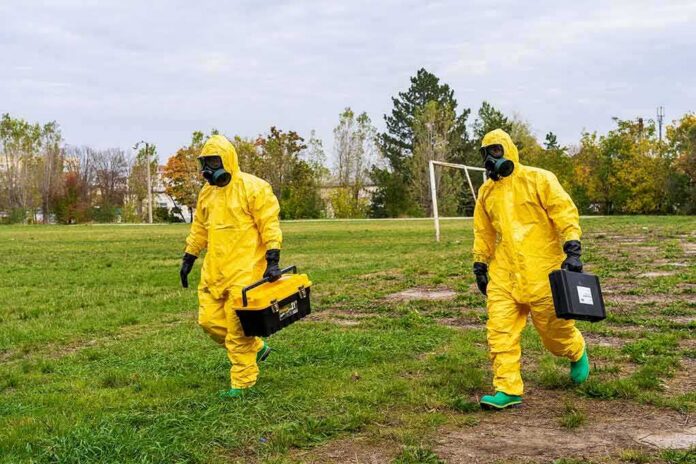
Bomb technicians shut down an Oceanside neighborhood after containers labeled “biohazard” and “top secret” triggered a full hazardous-material response.
Story Snapshot
- Officials closed roads and ordered nearby residents to shelter in place while teams assessed suspicious containers.
- Responders reported “biohazard” and “top secret” markings on coffee-can style containers, prompting maximum caution.
- A unified team used X-ray screening and cleared any explosive threat; no injuries were reported.
- Multiple agencies coordinated the response, reflecting standard training to treat unknowns as real threats until proven safe.
Officials Lock Down Streets After Suspicious Find
Oceanside Fire Department crews and police arrived late Sunday morning after a report of multiple suspicious containers near Castellanos Drive and Vandegrift Boulevard. Commanders quickly set a perimeter and closed parts of Vandegrift to traffic. Residents on nearby blocks were told to shelter in place while hazardous-material specialists evaluated the scene. The swift action followed standard safety playbooks for unknown substances and possible explosives, where the first priority is distance, control, and careful assessment.
Battalion Chief Blaine Hensley said the containers looked like coffee cans with lids and carried biohazard labels, with lids on most marked “top secret.” That unusual pairing raised red flags for responders, who treated the area as a potential hazardous and explosive scene. Officials called in the San Diego County Sheriff’s Office Bomb and Arson Unit and regional hazardous-material teams to assist Oceanside crews. The goal was to identify the risk before anyone got hurt and to keep the public away from possible danger.
Unified Response Brings Bomb Squad And Hazmat Teams
Oceanside Fire and Police led a unified command with San Diego County Environmental Health, San Diego Fire-Rescue hazardous-material specialists, Camp Pendleton hazardous-material personnel, and the county bomb unit. Each agency brought specific tools and training. Teams isolated the area, controlled access points, and ran a step-by-step process to find out what was inside the containers. This approach mirrors national guidance for suspicious packages and unknown substances, including perimeter control and staged entry.
Technicians used X-ray equipment to examine the containers before opening or moving them, reducing risk to first responders and neighbors. After those scans, commanders lifted the shelter-in-place order and reopened the area. Chief Hensley said the “explosive hazard was cleared.” That allowed families to resume normal life by Sunday afternoon. No injuries were reported during the incident, a sign that the layered safety process worked as designed and kept people out of harm’s way.
Why Labels Trigger Maximum Caution
Responders are trained to treat a suspicious label as a real threat until the facts say otherwise. Guidance for first arrivals stresses three steps: secure the scene, isolate the area, and notify specialized teams. Unknown substances and sealed containers with alarming markings demand distance and slow, methodical checks. Those steps protect residents, first responders, and nearby infrastructure. They also prevent panic by replacing guesswork with measured, documented tests before anyone declares an all-clear.
Officials also leaned on shelter-in-place orders for blocks nearest the scene. That tactic keeps people indoors and away from possible exposure or blast effects. It is a common tool for hazardous-material calls when evacuation could increase risk or clog roads needed by emergency crews. When combined with road closures and access control, shelter-in-place helps responders focus on the threat without crowds or traffic interfering with careful work.
Clear Facts, Limited Extras, And A Safe Outcome
Public updates tied the response to a defined time and location, a multi-agency command, the use of X-rays, and a declared clearance of any explosive hazard. Those facts match how hazardous-material and bomb teams operate in most cities. Some reports showed minor street-name inconsistencies, which can happen during fast-moving scenes covered by multiple outlets. But the core actions are not in doubt: a cautious lockdown, technical screening, and a safe release of residents to normal routines.
For conservative readers, one point stands out: strong local policing and emergency readiness protect families. When labels scream “biohazard,” delay invites danger. Here, trained teams moved fast, used the right tools, and communicated clear steps. That is how public safety should work. It respects the community, avoids chaos, and upholds order without drama. It also shows why funding core services and keeping politics out of emergency work matters when lives may be on the line.
Sources:
nypost.com, yahoo.com, patch.com, fire.ci.oceanside.ca.us, 10news.com, sandiegocounty.gov