

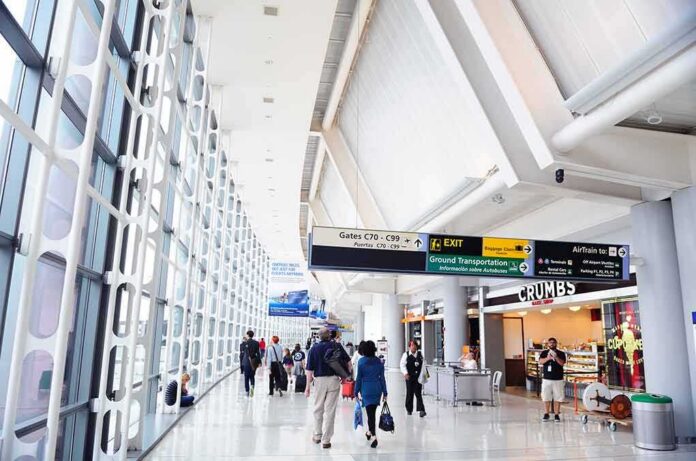
A rare nationwide ground stop froze all U.S. departures for hours as aviation communications faltered, then gradually restarted under tighter control.
Story Highlights
- The Federal Aviation Administration ordered all U.S. departures to stop “for reasons of safety.”
- Transportation officials cited communications trouble at air traffic control centers nationwide.
- Inbound international flights continued under case-by-case management.
- The stop was lifted after several hours once stability improved.
FAA Halts All Departures Under Safety Directive
The Federal Aviation Administration issued a nationwide ground stop on Friday evening, directing all departing flights at U.S. airports to remain on the ground. The Air Traffic Control System Command Center advisory cited “extraordinary circumstances” and ordered the pause “for reasons of safety.” The directive applied across the national airspace. Officials said they were acting to protect travelers while they sorted out operational problems that made normal communications unreliable for controllers and crews.
The advisory made clear that the stop covered departures but did not shut down the entire system. The Federal Aviation Administration said inbound flights would be handled on a case-by-case basis. That approach allowed arriving aircraft already airborne to land under tighter control, while avoiding new departures that would add risk. The targeted pause suggested the agency sought to buy time to steady key systems without triggering a total loss of order in busy terminal airspace.
Officials Cite Communications Instability, Old and Overloaded Gear
Transportation Secretary Sean Duffy said the Federal Aviation Administration acted after communications issues hit multiple Air Route Traffic Control Centers. He said radar and communications feeds showed instability and inconsistent data. He added that old switches and routers became overloaded with traffic, which worsened the problem. These details point to a technology strain rather than a single site failure. The agency’s own advisories described a communications issue and tied the decision directly to safety.
Officials also stressed what the event was not. Department leaders said there was no indication of a nefarious attack, while noting the situation was being reviewed. That statement matched the operational posture: pause departures to reduce risk, steady the networks, and then restart in stages. The facts fit a broader pattern since 2023, when a Notice to Air Missions outage forced a nationwide pause and exposed aging systems that still power flight operations every day.
Ground Stop Lifted After Hours As Operations Stabilized
The Federal Aviation Administration canceled the ground stop after several hours once stability improved and centers could manage traffic again. Reports placed the lift in the early evening, roughly four hours after the order. Airport activity picked up as crews worked through backlogs. Airlines then faced the hard part: clearing lines of aircraft and rebooking stranded passengers while keeping crews within duty-time limits and moving planes to their next legs safely.
Transportation Secretary Duffy said the agency first noticed trouble at 3:36 p.m. Eastern, when radar and communication links turned unstable. The ground stop followed as the scope widened. The precise minute of the restart varied in media accounts, but the direction of travel was clear: freeze, assess, steady, and resume. That sequence matched standard safety playbooks when reliable communications cannot be guaranteed for controllers or pilots who depend on up-to-the-second information.
Why This Matters For Travelers And Taxpayers
This was only the second nationwide ground stop since the September 11 era, with the other major pause tied to the 2023 Notice to Air Missions failure. Both events highlight a simple truth: even when aircraft are safe to fly, the system cannot function if the networks that move instructions and data get shaky. When that happens, the safe choice is to pause, then restart in a controlled way. It is disruptive, but it protects lives in crowded skies.
DHS Secretary Markwayne Mullin defended President Trump’s response to the nationwide FAA ground stop:
“He puts leaders in place, and he allows them to lead.”
The FAA has lifted the ground stop following major communications disruptions. Officials say aircraft landed safely. pic.twitter.com/zHXxrO15Pj
— TechAmerica (@techamericaofcl) November 14, 2026
For conservative readers who value competence and accountability, the lesson is direct. The federal government must modernize these core systems on time and on budget, not with bloated projects or vague timelines. The Trump administration’s team framed the pause as a safety-first call while pointing to old, overloaded technology that needs replacement. The focus now turns to delivering upgrades quickly, proving stewardship of taxpayer dollars, and preventing a third nationwide stop that strands families and hits the economy.
Sources:
youtube.com, people.com, nbcboston.com