
NASA’s FireSense program is turning wildfire sensing into a real-time tool for crews on the fire line, but the public record still shows more promise than proven field-wide results.
Quick Take
- NASA says FireSense is designed to improve detection, tracking, and smoke-plume monitoring for operational agencies.[3]
- FireSense campaign footage shows near-real-time feedback from technicians to burn crews during field testing.[4]
- The project’s public figures are mostly estimates and pilot results, not a full operational validation record.[1][3][4]
- NASA has also described a hardened sensor package for trial on firefighting bulldozers to improve situational awareness and safety.[1]
NASA’s Safety Pitch for FireSense
NASA’s FireSense project presents itself as a practical wildfire-management system, not a laboratory experiment. The agency says innovative sensors can track fires, fuel conditions, and smoke plumes with greater precision, while supporting operational agencies across the United States.[3] NASA Langley also says the project is focused on delivering Earth science and technology to agencies for measurable improvement in wildland fire management, with annual airborne campaigns and a larger capstone demonstration planned later in the program.[2]
That framing matters because the agency is tying the system directly to firefighter safety and incident support. NASA-linked University of Maryland reporting says FireSense is co-developing a hardened sensor package for trial on firefighting bulldozers, with the goal of improving situational awareness for the driver, protecting equipment, and contributing to firefighter safety.[1] In practice, that means the project is trying to give crews better information before, during, and after a fire instead of relying only on slower, traditional observation methods.[3]
Real-Time Data in the Field
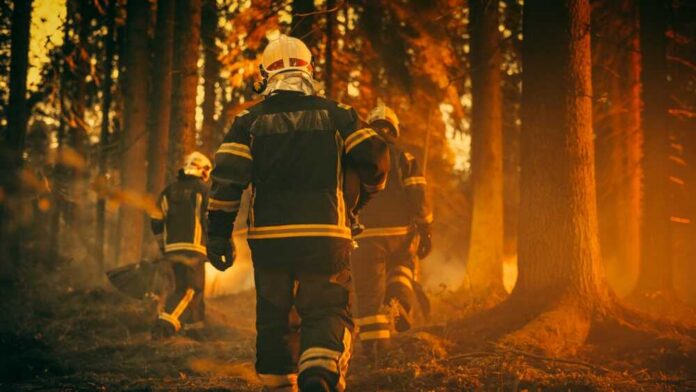
The strongest public evidence comes from NASA’s field-campaign video, where project participants describe real-time products being used with crews on active fires.[4] One segment says technicians on the ground talk to the burn crew on the fire line, gather feedback on what is useful, and then make adjustments.[4] Another says data can be pulled down within minutes and turned into maps of new starts for forestry managers, who can then deploy resources more quickly.[4]
That kind of speed is the central appeal for conservatives who want federal programs to prove practical value instead of producing only flashy demonstrations. NASA says FireSense improves active-fire dynamics through better detection and tracking using satellite, airborne, and ground-based imagery with higher spatial resolution and more frequent updates.[3] The project also says improved fire-spread models and smoke-plume monitoring support prescribed-fire decisions, wildfire management, and air-quality forecasting.[3]
What the Public Record Does and Does Not Show
The limitation is that the public material still emphasizes development goals, campaign footage, and projected capability more than independently verified performance. NASA’s own selection page describes the low-cost proliferated low-Earth-orbit concept as something being validated, and it estimates detection of fires as small as 10 square meters with a 15-minute cadence across the continental United States.[1] That is useful planning language, but it is not the same as a published record of operational accuracy, false-alarm rates, or sustained deployment results.[1]
BREAKING! NASA Develops Sensor to Improve Firefighter Safety. With peak wildfire season approaching, scientists with NASA’s FireSense project have created low-cost thermal sensors to install on fire bulldozers that will alert firefighters when heat from a nearby fire reaches a …
— Stellar Nomads (@StellarNomads) May 27, 2026
The same gap shows up in the broader FireSense narrative. NASA says the program addresses pre-fire fuels conditions, active fire dynamics, post-fire impacts and threats, and air-quality impacts and forecasting.[2][3] Yet the sources supplied here do not isolate what the thermal sensor itself accomplished versus what came from aircraft, drones, satellites, ground sensors, or models bundled into the larger system.[3][4] For readers who want accountability, that distinction matters because it shows whether the hardware is truly unique or simply part of a broader government technology stack.[3][4]
Why the Claim Still Needs Harder Proof
The public record supports the claim that NASA is developing wildfire sensors aimed at safer, faster decision-making, but it does not yet prove direct firefighter-safety gains. None of the supplied sources document fewer injuries, better evacuation timing, fewer entrapments, or incident-level safety outcomes tied to FireSense deployment.[1][3][4] The evidence is strongest on intent and pilot use, weaker on independently audited results, and weakest on large-scale adoption across a full fire season.[1][2][3][4]
That is the right standard for a taxpayer-funded project. If FireSense can truly help crews spot fire movement sooner, guide resources more efficiently, and protect lives and property, the program should publish sensor-specific performance data, full after-action reports, and independent comparisons against existing wildfire tools.[1][3][4] Until then, the story is best understood as a promising NASA demonstration with real operational potential, not yet a fully proven national solution.[1][2][3][4]
Sources:
[1] Web – NASA Develops Sensor to Improve Firefighter Safety
[2] Web – Additional Project Selections Made for FireSense Technology 2022 …
[3] Web – NASA “wildfire digital twin” pioneers new AI models | PreventionWeb