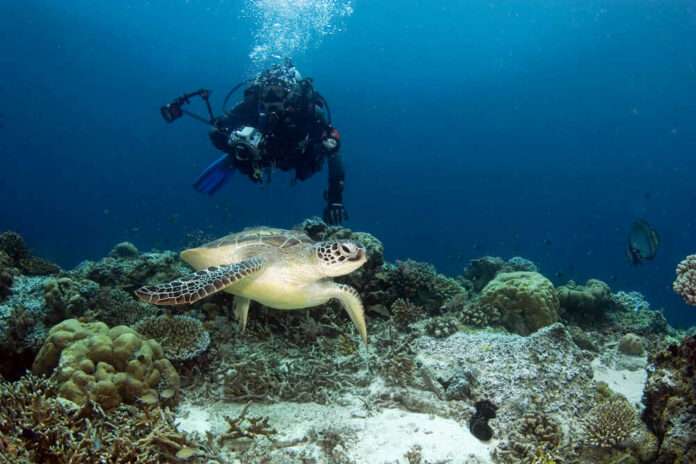
China’s claim that foreign “spy turtles” are prowling its coastline says more about Beijing’s paranoia and propaganda than about sea creatures turned secret agents.
Story Snapshot
- China’s security ministry claims foreign agencies use sensor‑fitted turtles, fish, and buoys to spy on its coast.
- The ministry describes real military-style ocean data collection but has shown no public hard evidence so far.
- State media push the “spy turtles” label, which grabs headlines and helps Beijing rally nationalism and control.
- For Americans, the story is a reminder: China is building a tight surveillance state while crying foul about others.
China’s ‘Spy Turtles’ Warning and What Beijing Actually Claims
China’s Ministry of State Security, its main domestic spy agency, posted a warning saying foreign intelligence services are “continuously collecting and stealing sensitive marine data” in Chinese waters.[1] The ministry says “spy turtles” and “spy fish” have been found with sensors attached, swimming in set areas, collecting data like water temperature, salinity, currents, and even seabed conditions, then sending it in real time to overseas satellites.[1][3] The post calls this an “unseen covert war” at sea.[3]
Beyond animals, the ministry claims it has also found high-tech surveillance buoys with weather and “high-precision” listening devices that can capture submarine sound signatures.[1][6] Officials say wave-powered and solar-powered “wave gliders” are roaming the seas to map the underwater environment and track ship movements.[1][4][6] All of this, Beijing argues, lets foreign powers build detailed underwater maps, study Chinese warships and submarines, and spot weaknesses in its coastal defenses and offshore energy fields.[1][3][5][6]
Evidence Gaps: Bold Accusations, Thin Public Proof
News outlets note that China has not named a single country, specific spy agency, ship, or program behind the alleged “spy turtles” campaign.[3][5][6] The ministry has not released photos, serial numbers, lab reports, or chain-of-custody records for the supposed captured turtles, fish, buoys, or wave gliders.[3][5][6] Reporters say the state post also does not reveal exactly where or when these devices were found, or how many there were, making the claims hard for anyone else to check.[3][5][6]
So far, everything the public sees comes from that one social media statement and state-linked reporting that repeats it.[1][3][5][6] There is no independent forensic confirmation from outside labs, neutral scientists, or foreign governments in the material reviewed. At the same time, there is also no detailed rebuttal from the West that walks through each claim and proves it false.[3][5] The story sits in a gray zone: technically plausible in broad outline but unproven in its most dramatic “spy animals” details.
Why ‘Spy Turtles’ Fits Beijing’s Security and Propaganda Playbook
China’s warning lines up with a broader pattern: coastal states worry about undersea spying near ports, submarine routes, and undersea energy lines, and major powers do race to control undersea data.[3][6] The specific variables China lists—temperature, salinity, currents, and acoustic signatures—are standard for both science and military tracking of submarines and underwater drones.[1][3][5][6] So the category of activity Beijing describes is very real, even if the “spy turtles” label sounds like a late-night comedy bit.
By choosing that label, China turns a dense intelligence issue into an image everyone remembers.[2][6] That helps it do several things at once: stir public fear, justify tighter control over foreign research gear, and rally Chinese citizens to report “suspicious” devices they find at sea.[3][6] The ministry has urged fishermen, researchers, and ship owners to turn in unusual buoys or equipment, building a kind of mass-participation security net offshore.[3][6] For a regime that already runs a deep surveillance state on land, extending that mindset to the water is a natural next step.
What This Means for America, Allies, and Maritime Freedom
For Americans, the “spy turtle” story is a reminder that China is pushing for control not just of airspace and cyberspace but also of critical sea lanes and undersea terrain. The same regime that tracks its own citizens with cameras and phone apps now asks them to scan the seas for foreign devices, while it complains about others “stealing data.”[3][6] This narrative can be used to crack down on legitimate foreign science work and private shipping in the region, all in the name of security.[1][3][5]
The spy turtle excuse is exactly as credible as the rationale China used in 2010 when it cut rare earth shipments to Japan over a fishing boat dispute — and that one worked anyway. The world scrambled. The lesson from then still applies: the justification doesn't need to be…
— Derrick Dao (@derrick_dao) June 13, 2026
China’s leaders also know Western media will latch onto the phrase “spy turtles,” turning a serious strategic issue into a viral oddity.[5][6] That helps Beijing paint itself as the victim while keeping the world talking on its terms. For the United States and its allies, the right response is not panic or mockery, but calm strength: keep building secure undersea networks, protect our own coasts and data, and stay clear-eyed about a rival power that mixes real threats with propaganda to gain an edge.
Sources:
[1] Web – WHAT? China Demands Foreign Intelligence Services Stop Using ‘Spy …
[2] Web – Stop sending spy turtles to snoop on us, says China – The Telegraph
[3] Web – China says “spy turtles” and “spy fish” deployed by … – CBS News
[4] YouTube – China Claims ‘Spy Turtles’ Found in Its Waters
[5] Web – What are spy turtles? China warns foreign agencies are using them
[6] Web – China claims ‘spy sea turtles’ are studying its coastline | Euronews