
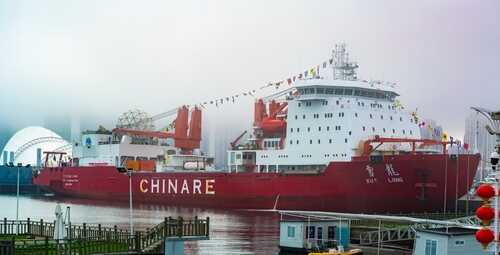
An uninvited Chinese research vessel has entered the U.S. Extended Continental Shelf in Arctic waters, raising alarms over sovereignty, security, and strategic intent.
At a Glance
- Chinese icebreaker Xue Long 2 detected 130 nautical miles into U.S. Extended Continental Shelf
- U.S. Coast Guard and Canadian air patrols responded with coordinated surveillance
- Beijing claims scientific research, but vessel path suggests strategic reconnaissance
- Increased Chinese and Russian presence fuels security concerns in Arctic
- Incident renews urgency around U.S. Arctic defense and territorial assertion
Icebreaker or Intruder?
The Chinese icebreaker Xue Long 2 was identified on July 25, 2025, deep within the U.S. Extended Continental Shelf (ECS)—nearly 290 nautical miles off the Alaskan coast. While not legally U.S. sovereign territory, the ECS grants America exclusive rights to explore and manage marine resources under international law. This region is not a no-man’s zone, and the vessel’s unannounced arrival immediately triggered a coordinated response from the U.S. Coast Guard and Canadian military.
Watch the report: Coast Guard responds to Chinese research vessel detected near Utqiagvik · YouTube
A C-130J Hercules aircraft was dispatched to document the ship’s presence, while a Canadian CP-140 Aurora monitored its course. The Chinese government has long framed its polar expeditions as benign scientific missions, but the Arctic’s rapidly changing climate and geopolitical dynamics cast a sharper light on what some analysts are calling strategic reconnaissance.
Arctic Chessboard Expands
China’s Arctic ambitions are no secret. Despite lacking territorial claims in the region, it self-identifies as a “near-Arctic state” and has launched a series of research missions over the past decade. The Xue Long 2, launched in 2019, is the crown jewel of these efforts: a domestically built, state-of-the-art polar research vessel capable of navigating heavy ice.
What makes this latest voyage so provocative is the ship’s course. It departed Shanghai in early July, navigated past Japan, transited through Russian waters, and then quietly entered the U.S. ECS. This indirect approach, combined with the lack of prior notice to American or Canadian authorities, has intensified suspicions. Officials from both countries confirm no laws were explicitly broken, but the strategic implications remain troubling.
Rear Adm. Bob Little of the U.S. Coast Guard emphasized that no foreign vessel—no matter its declared purpose—should expect unchallenged access to America’s Arctic frontier. In the face of growing competition over untapped resources and emerging trade routes, experts warn that tolerating such maneuvers could weaken U.S. influence in the region.
Testing Boundaries, Probing Resolve
The Arctic is quickly becoming a theater of silent confrontation. In 2024 and early 2025, Russian and Chinese military aircraft repeatedly approached Alaskan airspace, prompting rapid U.S. military responses. Now, maritime moves like those of the Xue Long 2 hint at an evolving strategy: test the lines, map the reactions, and find weaknesses in surveillance and jurisdiction.
Canada, while not directly intruded upon in this instance, remains on alert. Its military acknowledged the ship’s proximity but downplayed the threat level. Nonetheless, behind the scenes, both Ottawa and Washington are coordinating next steps. Arctic domain awareness, once a niche topic, is now a top-tier national security issue.
The incursion marks another warning flare. If America fails to assert its exclusive rights and reinforce Arctic defense infrastructure, future confrontations could escalate from symbolic to strategic. The ice may be thinning, but the stakes are only getting thicker.