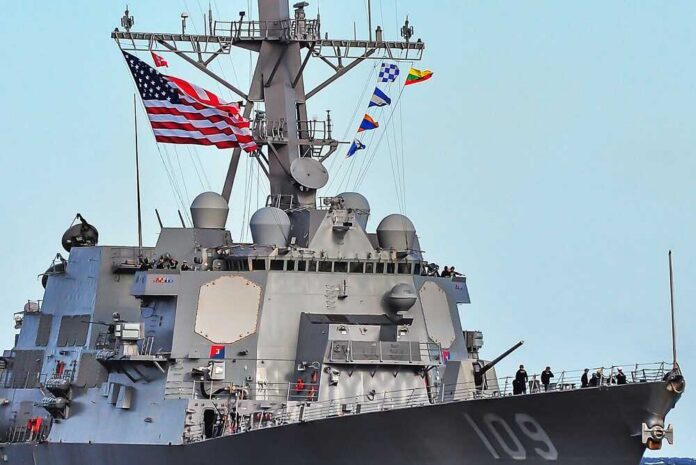
President Trump’s Navy is deploying modern battleships that outmatch China’s naval ambitions, restoring American sea dominance after years of neglect.
Story Highlights
- Arleigh Burke Flight III destroyers serve as today’s battleships with superior radar, missile defense, and firepower to counter China.
- Advanced AN/SPY-6 radar and Aegis Baseline 10 enable multi-target engagements against hypersonic and ballistic threats.
- Production ramps up in 2026, with ships like USS Jack H. Lucas already commissioned, bolstering Indo-Pacific deterrence.
- Each $2 billion hull sustains U.S. jobs and industry while pressuring rivals like China’s Type 055 destroyer.
Flight III: The New Backbone of U.S. Naval Power
U.S. Navy Surface Forces operate Arleigh Burke-class Flight III destroyers as multi-mission powerhouses. These 509-513 foot vessels displace 9,217-9,700 tons and exceed 31 knots speed. Equipped with 96 Mk 41 vertical launch system cells, they carry SM-6, SM-3, Tomahawk, and ASROC missiles. A 5-inch gun and torpedoes provide surface and subsurface punch. President Trump’s commitment to defense spending ensures continued production of these 25+ planned hulls through the 2070s. This counters years of underinvestment that weakened our fleets against peer competitors.
Technological Leap Over Legacy Systems
Flight III upgrades feature the AN/SPY-6(V)1 radar, outperforming the prior SPY-1D in range, target discrimination, and anti-jamming. Raytheon secured a $250 million contract in 2019 for these radar sets. Aegis Baseline 10 supports simultaneous engagements of aircraft, missiles, and ballistic threats. Enhanced power and cooling systems from GE Vernova’s LM2500 turbines deliver 100,000 shaft horsepower. These advancements address hypersonic missiles and anti-ship ballistic threats from China, ensuring carrier strike groups maintain air warfare commander superiority in contested waters.
Crews of 359-380 personnel benefit from automation reductions and MH-60R helicopters for anti-submarine warfare and search-and-rescue. General Dynamics Bath Iron Works and HII Ingalls Shipbuilding construct these hulls under multi-year procurement deals worth over $9 billion, securing thousands of American jobs in Maine and Mississippi.
Production and Deployment Momentum in 2026
USS Jack H. Lucas (DDG-125) commissioned in December 2023 marked the first Flight III delivery. By early 2026, two to three ships serve actively, with DDG-129 nearing completion and trials underway for others. Navy fact files confirm standardized specs for ongoing builds. Operational deployments focus on ballistic missile defense in the Pacific, directly supporting Trump’s strategy to deter Chinese aggression. This progress reverses Biden-era delays, prioritizing readiness over globalist distractions.
The U.S. Navy Already Has ‘Battleships’: Arleigh Burke Flight III Destroyers are a Real Powerhousehttps://t.co/JMzQtJNzGj
— 19FortyFive (@19_forty_five) March 12, 2026
Lockheed Martin integrates Aegis Baseline 10 and SM-3/SM-6 missiles, enhancing sales and BMD capabilities. Congress backs funding through FY2026 budgets, influenced by defense committees. Indo-Pacific allies gain enhanced deterrence, while the Aegis ecosystem pressures China’s Type 055, which lacks equivalent radar integration. Long-term, Flight III extends Burke relevance, delaying costlier successors amid fiscal discipline.
Sources:
The U.S. Navy Already Has ‘Battleships’: Arleigh Burke Flight III Destroyers are a Real Powerhouse
Naval Technology: Arleigh Burke-class
U.S. Navy Fact File: Destroyers (DDG-51)
National Interest: Arleigh Burke Flight III Upgrades
Seaforces: Arleigh Burke-class
Military Watch Magazine: US Navy Burke III