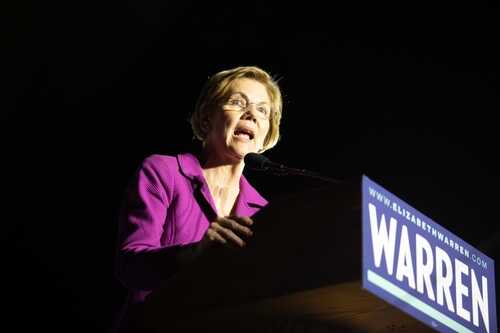
President Trump’s challenge for Senator Elizabeth Warren to take a drug test, delivered at a Social Security anniversary event, reignited partisan conflict and shifted focus from policy reform to personal attacks.
At a Glance
- Trump demanded Warren take a drug test during the 90th anniversary of the Social Security Act
- The remark overshadowed policy discussion and drew widespread media coverage
- Warren’s recent op-ed criticized Trump’s Social Security approach
- No formal drug testing policy exists for elected officials in the U.S.
- Analysts see the episode as fueling partisan polarization
Trump’s Provocation
On August 14, 2025, President Donald Trump used the stage of the Social Security Act’s 90th anniversary to reignite his long-running feud with Senator Elizabeth Warren. Addressing a national audience, Trump suggested Warren should “take a drug test,” a comment widely seen as a personal attack rather than a policy position.
Watch now: Trump Challenges Warren to Drug Test During Social Security Speech · YouTube
The remark came just days after Warren published an op-ed criticizing Trump’s handling of Social Security and endorsing Zohran Mamdani in New York’s mayoral race. Trump derided Warren’s endorsement as “communism,” rhetoric that political scientists note is consistent with his strategy of framing progressive figures as radical opponents. Analysts observed that Trump’s remark shifted coverage away from substantive reform proposals and toward spectacle-driven controversy.
A History of Clashes
The confrontation reflects a continuation of the adversarial dynamic between the two figures. Trump has targeted Warren for years, previously mocking her claims of Native American ancestry and questioning her credibility. Warren, in turn, has consistently positioned herself as a critic of Trump’s agenda, particularly on financial regulation and Social Security expansion.
Political observers such as Dr. Larry Sabato of the University of Virginia noted that Trump’s rhetoric was not intended to spark legislative debate but rather to galvanize conservative audiences. Similarly, Brown University’s Wendy Schiller highlighted how the dispute underscored deep partisan divides, with Warren emphasizing progressive reform and Trump framing himself as a defender of traditional programs against perceived radicalism.
Media and Public Response
News outlets reported extensively on Trump’s drug test demand, with most characterizing it as rhetorical hyperbole. The incident sparked discussions about civility in political discourse, especially as personal attacks continue to dominate public exchanges. Despite the intensity of the coverage, Warren has not responded directly to Trump’s remark as of August 16, 2025, leaving interpretation largely in the hands of analysts and commentators.
Social media reactions ranged from ridicule to defense, with supporters framing Trump’s remark as symbolic of accountability, while critics viewed it as undermining political norms. No evidence was presented to substantiate Trump’s claim, reinforcing the perception of the comment as political theater rather than a serious proposal.
Broader Implications
The controversy underscores broader tensions in American politics—whether personal confrontations are overshadowing debates on policy and governance. Experts warn that proposals for drug testing elected officials would raise constitutional and privacy concerns, making formal adoption unlikely. Nonetheless, Trump’s rhetoric demonstrates how confrontations can serve as tools to energize supporters and redirect media focus.
Commentators such as Matthew Continetti of the American Enterprise Institute argue that Trump’s tactics resonate with conservative voters who view his posture as resistance to government expansion. Meanwhile, critics caution that such spectacles erode trust in political institutions and distract from critical issues such as retirement security, fiscal policy, and constitutional rights.
As the Trump-Warren rivalry continues, episodes like this suggest that political discourse will remain entangled in a cycle of spectacle-driven confrontation, leaving substantive policy debates struggling for attention.
Sources
KFOX TV
Fox News
Forbes
Dailymotion