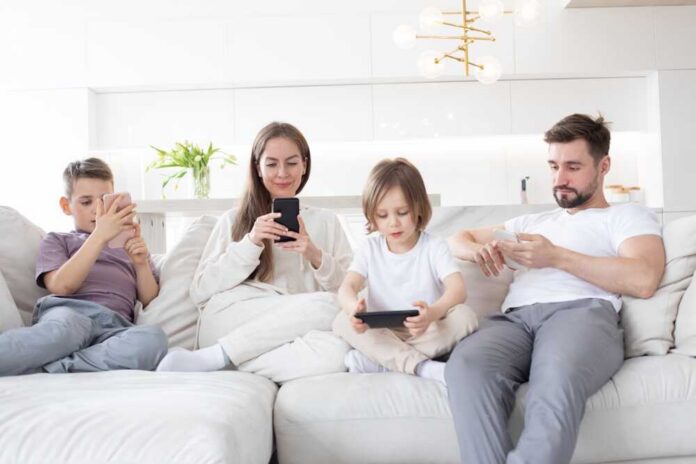
Smartphones aren’t just distracting kids—they’re quietly reshaping family life in ways that make parents less present and children more anxious, impulsive, and dependent.
Quick Take
- Researchers and clinicians link heavy phone use to behavior problems, sleep disruption, and anxiety—effects that can show up quickly in kids.
- Evidence suggests parents’ own screen habits can worsen child behavior by reducing attention, consistency, and calm discipline at home.
- A growing push for school cellphone restrictions and “phone-free” family rules reflects a cultural backlash against addictive app design.
- Real-world “flip phone” switches reported dramatic screen-time drops and more face-to-face conversation, but long-term data is still limited.
Why phones are accelerating childhood changes
Smartphones became mainstream in the late 2000s, but the most disruptive shift came when kids gained constant access to social feeds, messaging, and autoplay video—features engineered for repeated checking. Research and reporting summarized in recent years describe a pattern: more time on phones correlates with more sleep loss, anxiety, and social comparison, while real-world play and in-person conversation shrink. The speed of this change often leaves parents reacting after habits are entrenched.
Several sources also highlight a basic limitation: smartphones are still relatively new in children’s lives, so long-term, decades-spanning outcomes remain hard to measure with certainty. Even with that caveat, the available studies and clinical observations point in a consistent direction—especially when phone use crowds out sleep, physical activity, and family routines. For parents trying to protect childhood, the practical question becomes less about “screens” in general and more about constant connectivity.
How parents’ screen habits can intensify behavior problems
Family-focused research has drawn attention to “technoference”—moments when a parent’s phone interrupts normal interaction. Studies discussed by child-development experts describe an “awful cycle”: stressed parents retreat into their devices, children escalate misbehavior to regain attention, and the household becomes more reactive. Over time, that pattern can train kids to expect partial attention, shorter tempers, and inconsistent follow-through—conditions that make discipline harder and screen dependency easier.
This is one area where conservatives and liberals often land on the same frustration: families feel they’re losing control to systems built by wealthy, unaccountable tech interests. App business models reward maximum engagement, not healthy childhood development or strong families. From a limited-government perspective, the most immediate lever isn’t Washington—it’s parents reclaiming authority through rules that are clear, enforceable, and modeled by adults who also put their phones away.
What the “flip phone” trend reveals about addiction-like behavior
One of the most concrete developments comes from reporting on teens and families experimenting with flip phones or “dumbed-down” devices. Participants described steep reductions in screen time—sometimes from hours per day to minutes—along with less fear of missing out and more family conversation. Those accounts don’t prove every child will respond the same way, but they do reinforce a point many parents already suspect: when a device is designed to hook attention, moderation can be harder than it sounds.
Schools and policymakers move toward tighter limits
Public institutions are also testing boundaries. A U.S. Surgeon General advisory in 2023 warned about social media risks for youth mental health, and school cellphone restrictions have expanded in many states and districts. These moves reflect a practical concern: teachers can’t compete with vibrating pockets and endless notifications, and parents can’t assume “educational use” is what dominates the school day. Even then, enforcement varies, and rules can be undermined when home expectations don’t match school policy.
The main limitation across the debate is that much of the evidence combines peer-reviewed research with observational reporting and self-reported behavior, which can introduce uncertainty. Still, the trend line is hard to ignore: phones change kids fast, and they also change parents—often in ways that weaken attention, patience, and family cohesion. For families who feel the “system” isn’t protecting them, the most reliable defense remains local: household standards, tech-free zones, and adults leading by example.
Sources:
A Smartphone Will Change Your Child in Ways You Might Not Expect—or Want
Smartphones vs. flip phones: Teens cut screen time and social media use
Examining the effect of smartphones on child development