
China’s Xi Jinping just told the world that no single country should control artificial intelligence—and he wants his new global AI club to help set the rules.
Story Snapshot
- Xi Jinping says AI must not be dominated by one country and calls it a global public good.
- China launches a World Artificial Intelligence Cooperation Organization with 29 partner nations.
- Beijing attacks U.S. national security concerns as “overstretching” while pushing its own AI standards.
- America’s tech lead and data security could be at risk if China’s vision for global AI rules takes hold.
Xi’s Shanghai Speech: No “Solo Performance” in AI
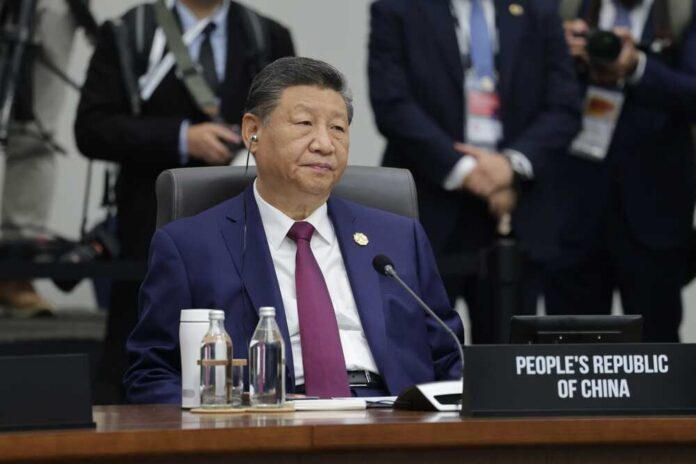
Chinese President Xi Jinping used the World Artificial Intelligence Conference in Shanghai to say that artificial intelligence should not be “dominated by a single country” and must be built through global cooperation. He claimed AI development should not be a “solo performance” but a “symphony of international cooperation,” framing the technology as a shared benefit for all humanity. Xi also said AI should stay under “human control” through laws, monitoring, and emergency systems, and pushed a “people-centric” approach to future AI tools.
Xi repeated a key idea he has raised before: artificial intelligence should become a “global public good” that helps the world, especially developing nations. He promised thousands of training slots for poorer countries and more joint projects with blocs like the Association of Southeast Asian Nations and the BRICS group. On the surface, this sounds generous. But it also positions China as the main partner and teacher for the Global South on advanced technology, which builds long-term influence.
China’s New AI Club Challenges U.S. Leadership
Right before the Shanghai summit, China announced a new World Artificial Intelligence Cooperation Organization, bringing together 29 countries, including Russia and Pakistan, under a China-linked AI framework. State and party outlets describe this body as an intergovernmental group to promote “global AI governance,” with its headquarters in Shanghai. This allows Beijing to claim it is leading a “just and equitable” AI order, and to write draft rules and standards that friendly governments may adopt over time.
Foreign ministry spokespeople in Beijing have argued that AI “should not be owned by major countries, still less dominated by contest and rivalry,” and say China wants an “open, equal-footed, just, and non-discriminatory environment” for AI development. That message sounds neutral, but it directly targets the current U.S. edge in chips, software, and cloud platforms. At the same time, expert research shows Chinese leaders still seek “world-leading levels” in AI and want critical technologies “firmly grasped in our own hands,” pointing to a long-term push for tech self-reliance and global market share.
Attacking U.S. Security Concerns While Seeking Rule-Setter Status
In Shanghai, Xi criticized what he called “overstretching the national security concept in the field of AI” and “placing one country’s security over that of others,” echoing earlier complaints about American export controls and data rules. He wants nations to resist national security “overreach” in AI, even as Chinese law gives his government broad power to access data held by Chinese firms at home or abroad. That tension matters for Americans worried about privacy, election security, and the safety of military and critical infrastructure systems.
Analysts note that China has spent years pushing new multilateral tech bodies to counter Western dominance whenever a key technology emerges, from internet governance to AI. In 2023, Xi launched a Global AI Governance Initiative, calling for principles that keep AI “under human control” and align development, rules, and standards across many countries. The new Shanghai-based organization is a concrete step toward that vision. If it gains members and respect, it could compete with U.S.-backed efforts and shape the norms that global companies must follow.
What Xi’s AI Vision Means for American Conservatives
For American conservatives, Xi’s call to stop any single-country “domination” in AI is really a call to limit U.S. leadership and influence in the digital world. Research on China’s AI strategy shows Beijing’s leaders see AI as critical for military power, economic strength, and control over information flows. They want to reduce dependence on foreign technology, secure their own supply chains, and then push their standards abroad. That raises real concerns about intellectual property, cyber security, and control of AI systems that touch U.S. data.
RT @KhaosodEnglish: Thai Prime Minister Anutin Charnvirakul joined Chinese President Xi Jinping and world leaders at the opening of the 2026 World Artificial Intelligence Conference (WAIC) in Shanghai on Friday. 🇹🇭🇨🇳#Thailand #China #AI #WAIC2026 pic.twitter.com/nHL2NzUyPX
— Warren Gerdes (@PopeKael) July 17, 2026
Global AI rules written in forums led by China and its allies could pressure American firms to comply with standards that do not share our values on free speech, privacy, or limits on state surveillance. At the same time, many United Nations discussions show broad support for new AI governance bodies, especially from Global South countries that welcome Chinese investment and training. That means the United States, under President Trump, must guard its technological lead, protect sensitive data, and stay deeply involved in AI diplomacy so our constitutional freedoms, national security, and market-driven innovation are not diluted by rules written in Shanghai instead of Washington.
Sources:
insiderpaper.com, singjupost.com, reuters.com, cnbc.com, youtube.com, fmprc.gov.cn, un.china-mission.gov.cn, research-archive.org, csis.org