
Secretary of State Marco Rubio has placed Venezuela’s oil money under direct U.S. control — and Congress still hasn’t seen a single audit after five months.
Story Snapshot
- The U.S. now controls Venezuela’s oil revenues, requiring the country’s interim government to submit a monthly budget for White House approval before any funds are released.
- Rubio told the Senate that 30 to 50 million barrels of Venezuelan oil will be seized and sold at full market rates, with proceeds held first in Qatar, then moved to a U.S. Treasury account.
- After five months, Congress has received zero audits, receipts, or contract lists — a transparency gap Rubio himself acknowledged during a Senate hearing.
- A private equity executive named Mauricio Claver-Carone reportedly influences which companies get Venezuelan oil contracts, yet he is not subject to federal financial disclosure rules.
Rubio Lays Out the Venezuela Oil Plan
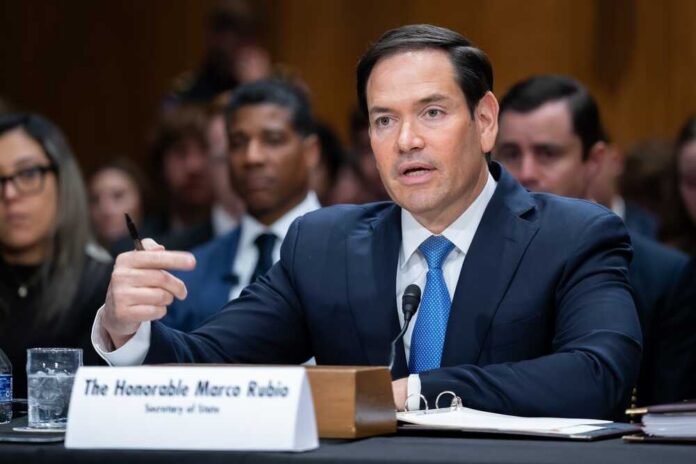
Secretary of State Marco Rubio testified before the Senate Foreign Relations Committee on January 28, 2026, explaining how the U.S. now controls Venezuela’s oil money. Under the plan, Venezuela’s interim government must submit a monthly budget to the White House. The U.S. reviews and approves it before any funds are released. Rubio said the goal is to stop corruption and make sure money reaches ordinary Venezuelans through basic services like policing and healthcare.
An executive order signed January 9 makes the U.S. the sole custodian of all revenue from Venezuelan resources. The order requires Rubio’s personal sign-off before any funds can be used. Rubio also told reporters the U.S. plans to seize and sell 30 to 50 million barrels of Venezuelan oil at full market rates — not the discounted prices China was paying. He called it a way to cut off corrupt middlemen and get real value back to the Venezuelan people.
Where the Money Is Sitting Right Now
Oil sale proceeds are currently held in a bank account in Qatar. The plan is to move that money into a blocked account controlled by the U.S. Treasury Department. Acting Venezuelan leader Delcy Rodríguez announced the funds would be split between two sovereign wealth funds — one for healthcare, one for public infrastructure and the electrical grid. But during the Senate hearing, Senator Jeanne Shaheen pressed Rubio on the whereabouts of $200 million from oil sales. Rubio confirmed it is “still sitting in the account” with no set release date.
The State Department claimed the oil revenues are being audited by the accounting firm KPMG, with KPMG paid by the Venezuelan government. But Rubio confirmed at the same hearing that Congress has received none of those audit reports. That is a direct contradiction — either the audits exist and were never sent to Congress, or they don’t exist at all. Either way, the result is the same: lawmakers have no documentation to verify how the money is being spent.
The Transparency Problem Congress Can’t Ignore
Five months into this arrangement, Congress has seen no audits, no receipts, and no list of which companies received Venezuelan oil or mineral contracts. That is a serious accountability gap — and one that Rubio himself pointed out. Rubio described the situation as lacking the transparency Congress needs to do its job. The Council on Foreign Relations noted that nearly 100 million barrels worth roughly $8 billion flowed through this system with almost no public accounting.
Adding to the concern, a private equity executive named Mauricio Claver-Carone reportedly acts as a “kingmaker” — influencing which companies receive Venezuelan oil contracts. He has taken private jet trips to Caracas and communicates regularly with Rodríguez, according to a Washington Post report cited during the hearing. Because he is not a federal employee, he is not required to file financial disclosures or follow conflict-of-interest rules. That means there is currently no way for Congress or the public to know whether he personally benefits from the contracts he influences. The administration’s Venezuela strategy may be sound in its goals — keeping oil money away from corrupt elites and directing it toward basic services is a legitimate aim. But legitimate goals require documented results. Congress and the American people deserve to see the receipts.
Sources:
youtube.com, latintimes.com, apnews.com, time.com, ms.now