Bomb technicians, federal agents, and miles of shut-down interstate turned a routine Chicago commute into a high-stakes mystery that raises hard questions about urban security and public transparency.
Story Highlights
- Illinois expressway closed for hours as bomb squad and federal agents responded to a reported explosion [2][9].
- One person was found dead in an SUV, with reports of shell casings near the vehicle [3].
- Initial scanner traffic and on-scene accounts differed on whether a bomb or gunfire caused the death [3][7].
- Authorities treated the scene as an “active incident,” reflecting a caution-first posture common in early investigations [2][7][10].
Chicago Expressway Incident Triggers Bomb Response And Federal Involvement
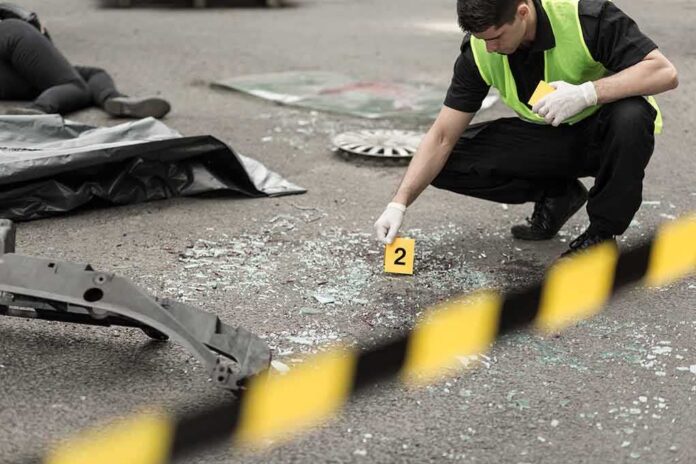
Illinois State Police shut down long stretches of the Eisenhower Expressway near Mannheim Road after reports of an explosion and a vehicle fire, prompting a full bomb squad deployment and the arrival of federal agencies. Broadcast footage showed a heavy police presence and technicians advancing on an SUV with deliberate caution while traffic was diverted in both directions for hours [2][9][10]. The disruption extended into the evening as investigators worked the scene and motorists faced gridlock across Chicago’s western suburbs [7][3].
Reporters on scene described the response as an “active incident,” with bomb technicians and specialized units moving in stages to secure the area [2]. Federal Bureau of Investigation (FBI), Drug Enforcement Administration (DEA), and Bureau of Alcohol, Tobacco, Firearms and Explosives (ATF) personnel joined Illinois State Police, reflecting a multi-agency framework that activates whenever explosives, firearms, or interstate safety could be implicated [8][9]. Officials emphasized safety while keeping details close as the initial cause remained unconfirmed [7][8].
Conflicting Early Accounts: Explosion Language Versus Gunfire Evidence
Early dispatch language and televised coverage repeatedly referenced an “explosion,” aligning with the decision to bring in bomb technicians [2][9]. However, separate on-scene and scanner reports indicated the deceased individual in the SUV may have suffered a gunshot wound, and that shell casings were found nearby—details that suggest gunfire at or near the vehicle rather than a confirmed bomb detonation [3]. This divergence illustrates how operational terminology can outpace forensic conclusions during the first hours of a major incident [7][2].
Illinois State Police and cooperating agencies did not immediately release final causation, leaving the public to parse limited facts while the expressway stayed closed for nearly nine hours [7]. That gap underscores a recurring pattern in fast-moving urban emergencies: authorities lock down a scene with maximum caution, public terminology leans toward worst-case scenarios, and verified answers arrive later after laboratory and ballistic work narrows possibilities [2][9][10].
Why The Heavy Response Matters For Public Safety And Accountability
Bomb squads and federal agents do not mobilize lightly; they operate under a “first, protect life” mandate that favors over-preparation when a car fire, a reported blast, and a fatality appear together on a crowded interstate [2][9][10]. For conservatives, that posture is welcome when it stops cascading danger, yet accountability also matters. Clear, timely updates help citizens distinguish between a bomb, an accidental ignition, or a shooting, all of which carry different policy and policing implications [7][8].
(VIDEO) Bomb Squad Called in Amid Reported Explosion on Chicago Highway – Person Found Dead in SUV Surrounded by Shell Casings
— 🇺🇸🇨🇿🇸🇪 PENNSYLVANIA IS TRUMP™ (@RED_IN_PA) June 5, 2026
Chicago’s congestion, shutdowns, and fear ripple far beyond city limits when major arteries close for most of a business day. Families lose hours, small businesses eat costs, and confidence in public order takes another hit. The Trump administration’s law-and-order focus expects straight answers: what happened, who is responsible, and how quickly can authorities harden the system against repeats? Those answers must come from evidence—ballistics, forensics, and device analysis—not hasty narratives [7][8][9].
Sources:
[2] Web – All lanes reopen after death investigation shuts down I-290 …
[7] Web – Truck explodes in Chicago’s western suburbs after crash, injuring …
[8] Web – Eisenhower Expressway reopens after person found dead …
[9] YouTube – DEA, ATF and FBI involved in investigation into explosion …
[10] YouTube – Authorities investigate explosion on Chicago expressway