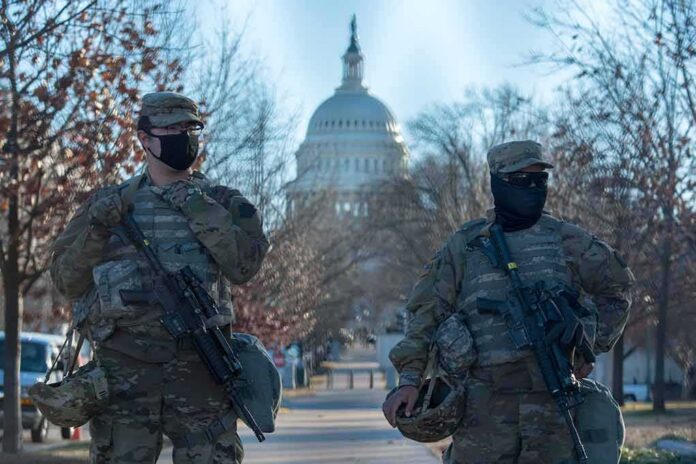
The Justice Department blasted the D.C. Council’s push to yank National Guard troops from the capital, calling the demand powerless and reckless.
Story Snapshot
- Justice Department told the D.C. Council it cannot order governors to pull their Guard troops from Washington.
- D.C. leaders argue the ongoing Guard mission is unlawful; a federal judge has ruled parts of the deployment exceeded authority.
- Blue-state officials are backing D.C.’s lawsuit to end the mission and restrict federal use of out-of-state Guard units.
- The clash centers on who controls public safety in the capital and how far federal power reaches.
Justice Department Rejects D.C. Council’s Demand
The Department of Justice told the D.C. Council that it has no power to direct governors to remove National Guard troops from Washington. The letter condemned the council’s outreach to 10 states as political and misleading about the mission’s legality. The department said the troops are serving under lawful orders and supporting security needs. Reporters described the message as a scathing rebuke that defended the Guard and dismissed the council’s claims of authority over out-of-state units.
The D.C. Council had urged governors to pull their troops, arguing the mission intrudes on local self-government. Council members framed the deployment as an unlawful use of military forces for routine policing. The Justice Department countered that council members cannot command governors or federal authorities. Officials emphasized that Guard members remain under proper command relationships and continue to assist with safety and deterrence duties in the nation’s capital as assigned by federal leaders.
Federal Court Ruling Complicates the Fight
A federal judge ruled that the administration’s use of more than 2,000 National Guard members in Washington for crime deterrence exceeded legal authority. The opinion found no clear basis to deploy out-of-state Guard units under the cited law and held that the action harmed D.C.’s home-rule powers. The court ordered an end to parts of the mission. That ruling energized D.C. officials and outside advocates who seek to curtail the federal role in local law enforcement operations.
News coverage reported that the judge’s decision targeted the extended, crime-focused deployment rather than every potential Guard assignment. The ruling sharpened a key line: federal leaders face stricter limits when using Guard troops for everyday policing. The Justice Department’s letter did not concede that the council holds any power over governors, even as legal appeals and follow-on orders play out. The dispute now turns on narrow statutory authority and how courts read Congress’s limits for Guard use in D.C..
Blue-State Attorneys General Join D.C.’s Challenge
California Attorney General Rob Bonta and other state officials filed an amicus brief backing D.C.’s lawsuit. They argued the deployment was unlawful, unconstitutional, and undemocratic, and pressed courts to restore clear lines between federal security and local policing in the capital. Their brief supports D.C. Attorney General Brian Schwalb’s bid to stop the mission. The filing adds political weight from progressive states seeking to check federal authority over the District’s day-to-day safety operations.
The broader clash tracks years of federalism tension in Washington. Federal officials highlight national security and continuity of government. D.C. leaders push for home rule and local control. Conservatives see the Guard as a lawful force that protects citizens, deters crime, and backs up stretched local agencies. Liberals call it militarized policing. The current ruling narrows the mission, but it does not grant the D.C. Council power over governors. That is the legal gap the Justice Department spotlighted.
What This Means for Public Safety and the Constitution
For families and workers in the capital, the stakes are clear: safety on the streets and a government that stays within the law. The court ruling raises the bar for using out-of-state Guard units for routine policing. The Justice Department’s response reminds D.C. that it cannot command other states. The next steps likely include adjusted mission orders, appeals, or a narrower Guard role tied to defined federal interests, not open-ended crime deterrence.
Conservative readers should watch two tracks. First, public safety must not be sacrificed to politics. If local crime spikes, leaders owe people real protection, not press releases. Second, constitutional lines matter. Congress, not the D.C. Council, sets many rules for the capital. Courts will police any federal overreach. But city officials cannot strong-arm governors or undermine service members who follow lawful orders. Expect continued court action and a tighter focus on missions that fit clear legal authority.
Sources:
thegatewaypundit.com, justthenews.com, washingtonpost.com, dccouncil.gov, pbs.org, youtube.com, foxnews.com