

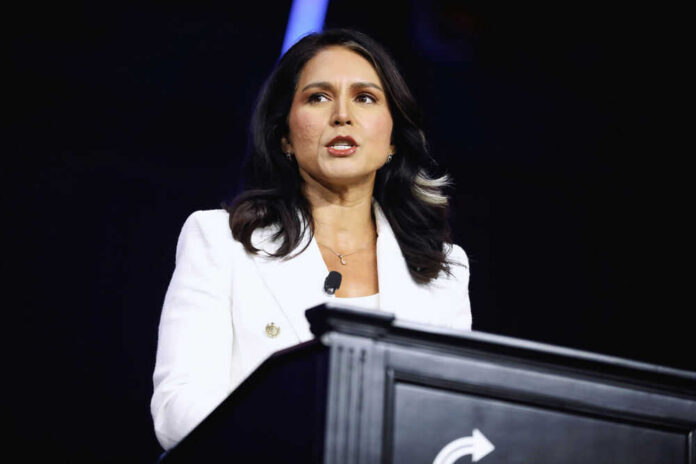
Tulsi Gabbard’s jump from Democratic rising star to Trump’s Director of National Intelligence shows how fast the old party lines collapse when the “America last” foreign-policy crowd demands loyalty.
Story Snapshot
- Tulsi Gabbard left the Democratic Party in 2022, went independent, then joined Republicans in 2024 and endorsed President Trump.
- Trump nominated Gabbard as Director of National Intelligence, and the Senate confirmed her despite criticism over earlier Syria- and Russia-related positions.
- Her political profile mixed populist themes with a consistent anti-interventionist message shaped by her military service.
- Her shifts on issues such as guns and trans sports aligned more closely with GOP norms while her “anti-war” posture remained central.
From Democratic Insider to Party Break: What Actually Changed
Tulsi Gabbard built her early national profile inside the Democratic Party, including serving as vice chair of the Democratic National Committee before resigning in 2016 and endorsing Bernie Sanders. She later ran for the 2020 Democratic presidential nomination, ended that bid, and endorsed Joe Biden. After leaving Congress in 2021, she broke with Democrats in October 2022 and later moved into a formal GOP role.
Gabbard’s backstory matters because it explains why her break landed with such force in a country exhausted by endless overseas entanglements and elite-driven consensus. She served in the Hawaii Army National Guard and deployed to the Middle East, experience that repeatedly shows up in how she talks about war, intelligence, and the cost of intervention. Over time, her public identity became less “party loyalist” and more “dissenter,” especially when Democratic leadership and activist factions pushed rigid orthodoxy.
Foreign Policy, Syria, and the Scrutiny That Followed
Criticism of Gabbard has often centered on her views and actions related to Syria and broader U.S. intervention policy. The available research reflects that she faced renewed scrutiny during the DNI nomination process, with opponents pointing to past statements and positions involving Syria and Russia/Ukraine. At the same time, multiple sources characterize her core message as anti-interventionist rather than pro-adversary, which is a key distinction when weighing the evidence presented.
On Capitol Hill, Gabbard also worked on policy efforts that cut across party lines, including legislation connected to opposing regime-change efforts and emphasizing vetting and prioritization in refugee policy after ISIS-era attacks. Those positions put her at odds with segments of the Obama-era foreign-policy approach and later Democratic messaging. For many conservative voters who watched “forever wars” expand while border security and domestic stability slipped, her emphasis on restraint reads as a corrective, not a retreat.
How Trump’s DNI Pick Became a Realignment Test
By 2024, the political arc was clear in the research: Gabbard joined the Republican Party, endorsed Trump, and then became his pick for Director of National Intelligence, ultimately confirmed by the Senate. Sources describe a polarized response—Democrats pressed concerns about her earlier foreign-policy record, while Republicans and veterans defended her. The confirmation fight effectively turned into a referendum on whether dissent from interventionist consensus disqualifies a candidate.
Domestic Issues, Culture Fights, and Why Voters Noticed
The record also shows Gabbard’s evolution on major domestic flashpoints. Research indicates she shifted on topics including abortion, the environment, gun policy, and trans sports in ways that better matched Republican norms, while keeping her “common sense” branding. For conservatives who lived through the prior era of top-down cultural enforcement—DEI mandates, speech policing, and bureaucratic overreach—her trajectory illustrates how cultural pressure inside the modern left can push dissenters out rather than persuade them.
It emphasizes her trajectory through 2024 and do not offer detailed, post-confirmation operational specifics about her day-to-day DNI agenda. What is clear is the broader political signal: Trump elevated a former Democrat with a military background to a top intelligence role, and the Senate’s confirmation validated that choice despite loud objections. That outcome matters to voters who want competence, restraint abroad, and less ideological gatekeeping at home.
Sources:
Tulsi Gabbard Democrat Republican Political Evolution History Trump