

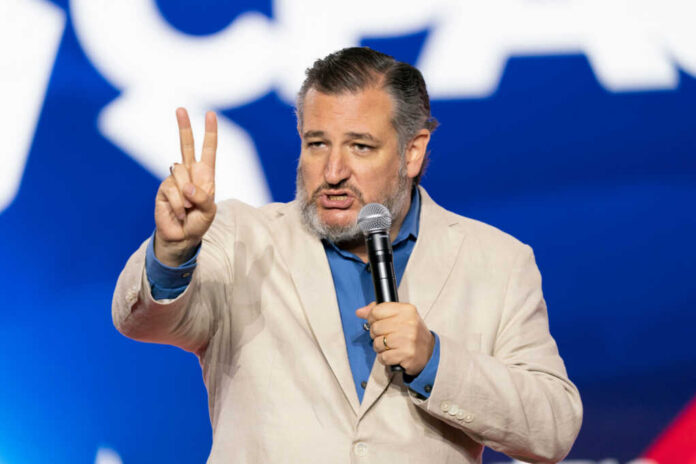
A fresh round of online infighting is putting one question back on the table for the GOP: are conservatives going to defend religious liberty equally, or pick favorites and punish the “wrong” Christians?
Story Snapshot
- Sen. Ted Cruz drew backlash after amplifying a Substack article that harshly attacked “traditional Catholics,” including Latin Mass communities and SSPX-adjacent circles.
- The controversy followed Cruz’s earlier remarks that “Christ is King” can function as an antisemitic dog whistle when used by certain far-right groups.
- Critics argue the shared article leaned on broad-brush stereotypes—portraying traditional Catholics as “foreign,” conspiratorial, and politically subversive.
- The fight exposes a real fault line inside the conservative coalition: evangelical Zionist politics versus a growing traditionalist Catholic influence online.
Cruz’s repost triggers a new intra-right religious fight
Sen. Ted Cruz (R-TX) faced renewed criticism in mid-March 2026 after sharing—and later refusing to walk back—an article by a Substack writer using the name “Insurrection Barbie.” The piece targeted “traditional Catholics,” including Latin Mass hardliners and SSPX-adjacent believers, and framed them as a threat to evangelical political dominance inside the Republican coalition. The online fallout intensified because the article’s language was not simply theological; it painted an entire segment of Christians as suspect actors in American public life.
A central problem is scale: the argument was not aimed at a specific extremist faction, but at a broad and loosely defined religious subculture. Critics say that kind of rhetorical net inevitably catches ordinary families—people who homeschool, attend reverent liturgies, and want less cultural chaos—right alongside fringe personalities. Research sources also indicate the exact date and full context of Cruz’s repost are debated, but multiple accounts place it around March 15–16.
The “Christ is King” dispute set the stage for escalation
The Cruz controversy did not start with the Substack repost. Earlier in March, Cruz drew heavy backlash after discussing the phrase “Christ is King” and asserting it can operate as an antisemitic signal when used by certain far-right groups—described in one report as effectively meaning “screw you, Jew.” That claim landed like a grenade because “Christ is King” is also a basic Christian confession used across denominations, including many mainstream believers who reject racial politics outright.
The problem for coalition politics is obvious: when public figures treat a historic Christian phrase as inherently suspect, they risk smearing millions of normal worshippers because a smaller set of online agitators misuses it. It does not show Cruz issuing a clear, narrow distinction that would reassure ordinary Christians that the phrase itself is not the target. Instead, the subsequent repost of a sweeping anti-traditional-Catholic critique looked, to many readers, like doubling down rather than de-escalation.
What the anti-traditional-Catholic article allegedly argued
The shared Substack article described traditional Catholics using inflammatory labels—“parasites,” “foreign,” and “Latin Mass hardliners”—and tied them to “integralism,” generally described as a political theology seeking society’s submission to Catholic teaching. It also portrayed traditional Catholic outreach as a deliberate project to recruit young evangelicals and weaken the Republican base from within. Even when a writer raises real concerns about extremism, blanket language like this tends to read as prejudice rather than analysis.
One reason this matters to a constitutional, limited-government audience is that America’s religious liberty is supposed to protect unpopular minorities as well as majorities. The First Amendment does not create “approved” and “unapproved” Christians. The research also notes that SSPX remains canonically irregular with the Vatican, which complicates attempts to define what counts as “everyday Catholicism.” That nuance makes broad accusations even riskier, because they can misrepresent who actually holds institutional authority in the Church.
The conservative coalition cost: sectarian lines replace shared priorities
In practical political terms, the biggest impact is not doctrinal—it’s strategic. The research indicates evangelicals have long held significant influence in Republican politics, while online traditional Catholic communities have grown, especially among younger converts reacting to cultural decline. When a prominent senator amplifies material that frames those converts as an internal threat, the movement wastes energy on sectarian policing instead of focusing on shared priorities like border security, parental rights, inflation, and restraining federal overreach.
Limited evidence suggests this fight is already being used as a loyalty test: pro-Israel evangelical politics versus an emerging Catholic traditionalist critique of modern liberalism and globalist assumptions. It also flags a key uncertainty: there is no clear, direct quote showing Cruz explicitly “doubling down” after the repost beyond the overall pattern of not retracting and previously defending related claims. That makes it important to separate verifiable action (the repost and earlier comments) from interpretation.
Why this story resonates beyond theology
This dispute is ultimately about whether conservatives can defend pluralism inside their own ranks without surrendering core truths. Conservatives rightly reject “woke” purity spirals on the left; replicating them on the right—by delegitimizing whole religious communities as inherently dangerous—invites the same division and censorship mentality. If the GOP is serious about protecting faith in public life, it has to be serious when the faith looks different than a politician’s home tradition, and when online narratives tempt people into scapegoating.
It also shows the information ecosystem problem: most of the detailed reaction is coming from ideological media—YouTube commentators and niche religious blogs—rather than broad, neutral outlets. That does not make the controversy unreal, but it does mean readers should demand clarity: What, exactly, did Cruz endorse? Which claims in the shared article are factual, and which are polemical? Until those questions are answered directly, the safest conclusion is that the rhetoric inflamed tensions inside a coalition that cannot afford more self-inflicted wounds.
Sources:
Ted Cruz claims saying ‘Christ is King’ is antisemitic, sparks backlash; is he Christian?