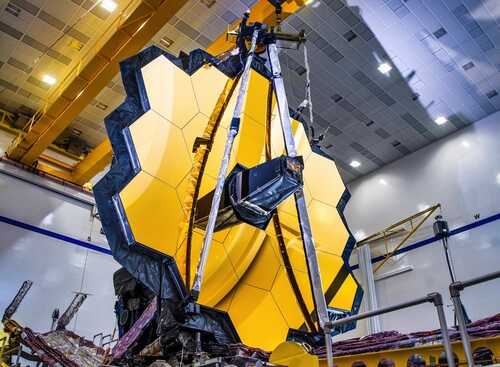
A new astronomical discovery from the James Webb Space Telescope (JWST) is rewriting the history of the early universe. Astronomers have finally solved the mystery of the compact “little red dots” observed in deep-field images, identifying them as young supermassive black holes (SMBHs) from just 600-800 million years after the Big Bang. This breakthrough is significant because these SMBHs are uniquely enveloped in dense, ionized gas, a finding that dramatically reshapes our understanding of black hole and cosmic structure formation in the universe’s infancy.
Story Highlights
- The mystery of the “little red dots” in space has been solved.
- These objects are identified as young supermassive black holes (SMBHs).
- The SMBHs are enveloped in dense, ionized gas that obscures typical emissions.
- This discovery sheds light on early universe formation theories.
James Webb Space Telescope’s Breakthrough Discovery
Since the launch of the James Webb Space Telescope (JWST) in 2021, astronomers have been intrigued by the presence of compact red dots in its deep-field images. These dots, appearing between 600-800 million years after the Big Bang, initially puzzled scientists, leading to debates about their nature. Recent studies have identified these phenomena as young supermassive black holes (SMBHs) shrouded in dense ionized gas cocoons. This discovery is crucial for understanding the early universe and the formation of cosmic structures.
The research published in January 2026 in Nature resolves a longstanding mystery and overturns initial theories that these dots were either massive early galaxies or SMBHs with implausible formation timelines. Instead, these cosmic entities are young SMBHs, ranging from 10^5 to 10^7 solar masses, wrapped in dense gas cocoons that obscure typical X-ray and radio emissions, thus altering their observed characteristics.
Scientists solve the universe’s mystery of little red dots: Black hole
➡️ https://t.co/adijS7Ux3I pic.twitter.com/FlwG9vMxXH— Euronews Next (@euronewsnext) January 16, 2026
Impact on Cosmology and Scientific Models
This breakthrough answers critical questions about the universe’s evolution during the first billion years. The discovery of SMBHs in such early cosmic history challenges existing models of black hole and galaxy formation, suggesting that these black holes might form directly from gas collapse or through rapid growth from smaller seeds. This finding not only refines our understanding of the early universe but also guides future observational strategies for the James Webb Space Telescope and other upcoming missions.
Vadim Rusakov of the University of Manchester, a leading author of the study, highlights the significance of this discovery by modeling the cocoons and calculating black hole masses through gas velocities. His work, along with that of Darach Watson from the University of Copenhagen, contributes to a growing consensus among astronomers regarding the nature of these enigmatic objects and their role in cosmic reionization.
Future Directions and Observational Strategies
With the current findings, astronomers plan to focus future JWST observations on the chemical composition of these gas cocoons to gain further insights into the black hole seeding process. This is expected to illuminate the formation mechanisms of the earliest cosmic structures, challenging previously held theories and possibly revealing new dynamics in the universe’s infancy.
While this discovery primarily impacts the astronomical community by refining scientific models, it also highlights the success of the JWST mission, justifying its substantial investment. The findings inspire further exploration and funding for space telescopes, such as the upcoming Roman Telescope, ensuring continued advancements in our understanding of the universe.
Sources:
Researchers solve mystery of universe’s ‘little red dots’
Scientists solve mystery of little red dots seen by James Webb Space Telescope | Euronews
Little red dots in other galaxies may be black holes wrapped in gas cloud cocoons
James Webb Space Telescope’s mysterious ‘little red dots’ may be black holes in disguise
Strange little red dots in space have a mind-boggling explanation, scientists discover