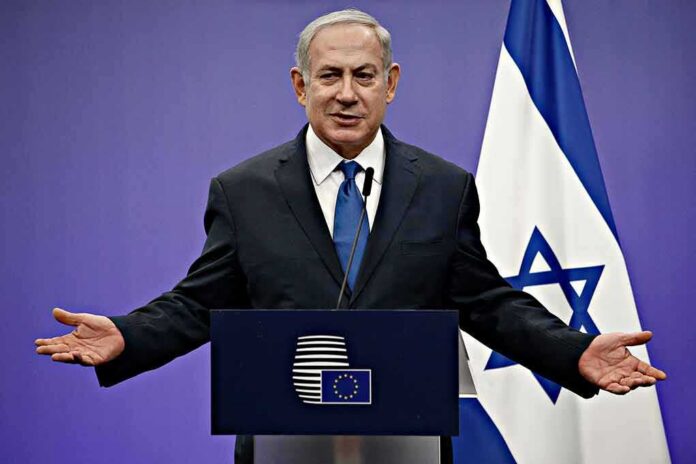
Amid loud genocide accusations at the United Nations, Benjamin Netanyahu doubled down on Israel’s Gaza campaign as a direct response to October 7 and vowed to “finish the job” against Hamas — and the clash over facts versus rhetoric is on full display.
Story Snapshot
- Netanyahu tied the war to Hamas’s October 7 attack and said Israel must defeat Hamas.
- He claimed mass civilian warnings and large aid flows proved Israel’s restraint.
- UN bodies and rights groups pressed war crimes and genocide accusations, keeping the dispute heated.
- The core debate centers on warnings, human shields, and whether aid and precautions were effective.
Netanyahu’s Core Case: October 7 Trigger and War Aims
Israeli Prime Minister Benjamin Netanyahu told the United Nations that Hamas’s October 7 attack triggered the Gaza war and that Israel must win and “finish the job.” He framed the campaign as necessary to stop future terror and to dismantle Hamas’s military power. Media reports described walkouts during his speech, but his message did not shift. He argued the fight targets Hamas, not civilians, and that ending operations early would reward terror and invite more bloodshed.
Netanyahu also rejected genocide claims as “the greatest lie of the century.” He said Israel’s conduct showed restraint and purpose, aimed at Hamas units placed among civilians. He insisted Israel would keep going until Hamas cannot threaten Israeli families again. Coverage captured both his defiance and the political theater around him, including sharp criticism from some delegations that left the hall, underscoring the deep divide over Gaza.
Warnings, Human Shields, and Aid: What He Says, What Critics Challenge
Netanyahu said Israel sent millions of texts, calls, and leaflets to warn civilians before strikes, and that Hamas used hospitals, schools, and homes as shields. He said these steps proved Israel tried to protect civilians while targeting fighters. He added that Israel enabled large food deliveries and even cited mass polio vaccinations to show humanitarian care. Supporters say these efforts reflect lawful, restrained warfare under brutal conditions.
Critics counter that many of these claims are self-reported and lack open operational proof. A United Nations fact-finding record has questioned how effective past warnings were in Gaza’s reality, where safe routes are scarce and messages can be confusing. Reporters and analysts also flagged that the “millions of warnings” and “millions of tons of aid” lines need solid data trails to confirm they reached people in time and at scale. That evidence gap fuels skepticism in global forums.
Genocide and War-Crimes Allegations Keep the Pressure High
International criticism stayed intense. A United Nations commission described “reasonable grounds” pointing to genocide acts by Israeli authorities, adding to the heat around the war’s legality. The United Nations human rights chief said the recovery of hundreds of bodies from rubble raised new concerns about possible war crimes, placing fresh focus on targeting choices and civilian harm during strikes. These statements keep Israel’s defense under a global microscope.
Advocacy groups have charged Israel with indiscriminate attacks, collective punishment, and using starvation as a weapon. Human Rights Watch said Israeli actions forced mass displacement and violated the laws of war, a claim Israel rejects as biased and incomplete. This duel over facts versus intent shapes policy fights at the United Nations and in allied capitals. It also pressures aid flows, ceasefire terms, and accountability debates as the conflict endures.
What Matters for Americans: Truth, Law, and Terror Defeat
For American readers who value strength, clarity, and the rule of law, three points stand out. First, Hamas began this war with the October 7 massacre, and any end state that leaves it able to strike again is dangerous. Second, facts should rule the debate. If Israel has logs of warnings, targeting reviews, and aid records, releasing them would undercut hostile forums and prove restraint. If critics have verified evidence, it should be tested plainly and publicly.
Third, the law of war demands two things at once: protect civilians and defeat terror. Urban combat makes both harder. That is why the key test is not only whether warnings were sent or aid allowed, but whether warnings worked and aid actually reached families in need. Clear data can answer that. Until then, world bodies will keep issuing charges, and Israel will keep rejecting them. The stakes are high: justice for civilians and safety from terror must both prevail.
Sources:
youtube.com, jns.org, aa.com.tr, bbc.com, apnews.com, un.org, france24.com, sbs.com.au, nbcnews.com, afp.com, thenationalnews.com, nypost.com, ynetnews.com, reuters.com, en.royanews.tv, hrw.org, lieber.westpoint.edu