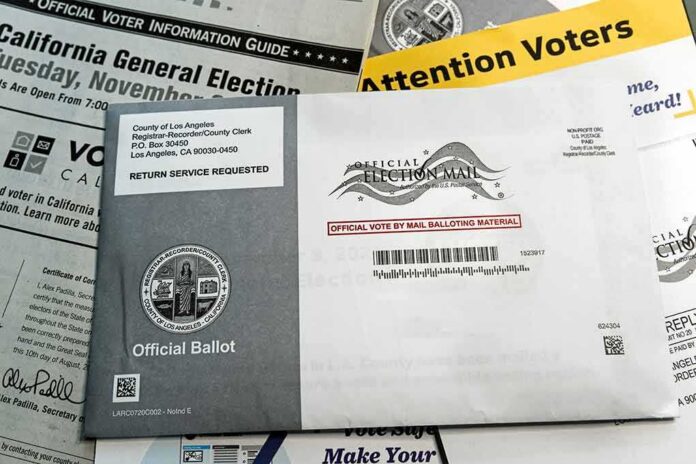
A late-night flood of “mystery” ballots in deep-blue Los Angeles is turning Spencer Pratt’s clear runoff path into yet another lesson in why Americans no longer trust big-city election counts.
Story Snapshot
- Spencer Pratt led Nithya Raman for days in the Los Angeles mayoral primary, yet late batches of ballots are rapidly erasing his edge.[1][2]
- Media and county data glitches fueled confusion when one update briefly showed zero new votes for Pratt while Bass and Raman surged, triggering fraud concerns online.[2]
- Officials now insist it was just a “data mix‑up,” but their explanation hinges on split electronic updates that ordinary voters could not see or verify.[2]
- The fight for second place will decide who faces Mayor Karen Bass in November, and late-count patterns again favor the entrenched political establishment.[1][2][3]
Pratt’s Runoff Lead Shrinks As Late Ballots Favor The Left
Several days after Los Angeles voters went to the polls, Spencer Pratt’s once-comfortable lead over far-left councilmember Nithya Raman for the second runoff spot has collapsed to a razor-thin margin, driven almost entirely by late-counted ballots.[1][2] Early returns and media analysis showed Pratt securely in second place behind incumbent Mayor Karen Bass, running strongest in the more centrist Westside and valley neighborhoods that had previously backed reform-minded candidates.[1] As additional mail ballots were tabulated, however, Raman’s totals spiked while Pratt’s advances slowed to a crawl, raising fresh questions about ballot timing and transparency in the country’s largest Democratic stronghold.[2]
According to detailed tallies reported in both local and national outlets, Pratt’s advantage over Raman shrank from well over twenty thousand votes to roughly a single percentage point as successive updates landed in the days after the election.[1][2] One count cited showed his raw edge tumbling to just a few thousand votes, with Raman gaining more than twice as many new ballots as Pratt in the latest batch.[1] This pattern mirrors what many conservatives have watched in other urban contests: establishment-aligned candidates trailing or tied on election night but slowly overtaking opponents as mail-in and late-arriving ballots are processed long after most citizens tuned out.[1][2]
Media “Mix-Up” On Zero Pratt Votes Deepens Public Distrust
While frustrated voters tracked the shrinking gap, a separate controversy exploded when election-result pages briefly displayed an update in which Bass and Raman received tens of thousands of new votes and Pratt appeared to receive none.[2] That screenshot spread rapidly online and was cited by skeptics as evidence that late ballot drops were being engineered to freeze out the more outsider-friendly candidate.[2] In response, the Los Angeles County registrar’s office and The Los Angeles Times later argued that the apparent shutout was simply a technical quirk in how the Associated Press fed data to news sites, not proof of a ballot batch that ignored Pratt.[2]
County spokesperson Michael Sanchez said the county’s internal records show that “at no point” did any official update exclude votes for Pratt, insisting that the problematic display resulted from two separate electronic transmissions that split a single batch into back‑to‑back updates.[2] Under this explanation, one data pull contained votes for Bass and Raman but not Pratt, and a second feed seconds later delivered Pratt’s votes but no additional ballots for Bass or Raman.[2] For many observers, that may sound like an innocent clerical detail, but to citizens already wary of partisan election offices and opaque counting procedures, it reinforces how fragile trust becomes when critical information is filtered through media and software layers they cannot independently confirm.[2]
Runoff Stakes: Bass Faces A Safer Opponent If Pratt Is Pushed Out
Behind the dispute lies a simple political reality: whoever finishes second will challenge Karen Bass in November, and the emerging establishment narrative is that Pratt is less dangerous to the incumbent than Raman.[3] A University of California, Berkeley and Los Angeles Times poll just before the election showed Bass leading a tight three-way field, with Pratt a few points behind but still within striking distance of both Bass and Raman among likely voters.[3] In hypothetical runoff testing, however, Bass held a sizable advantage over Pratt, while commentary from outlets such as CalMatters characterized Pratt as falling “short of a result that would make him a threat” to the mayor.[3]
The whole race is “non-partisan” by law. Is Karen Bass not a Democrat? Is Spencer Pratt—a registered Republican since 2020—not actually a Republican?
— JSK Map (@jskmap1284) June 7, 2026
That framing matters because it shapes how late-count swings are interpreted: a tightening race between Pratt and Raman is presented as an internal contest for a foregone conclusion, rather than as a live decision about which challenger gives voters a clearer contrast on crime, homelessness, spending, and law-and-order priorities.[3] For conservatives watching from around the country, the pattern is familiar: a heavily Democratic city relies on sprawling vote-by-mail systems, partial returns are treated as final when they favor the status quo, and any skepticism about sudden ballot surges for progressive candidates is waved away as “conspiracy,” even when basic data presentation errors fuel the confusion.[1][2]
Sources:
[1] Web – Pratt’s Lead VANISHES: California’s Shady Late Drops Appears to be …
[2] Web – L.A. divided: Bass, Pratt and Raman dominated in different parts of …
[3] Web – Raman closes in on Pratt as more votes in L.A. mayor’s race are …