
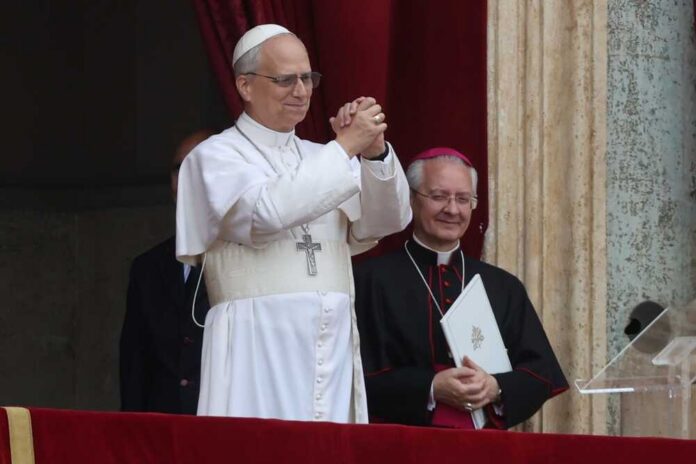
Pope Leo XIV told Spain’s lawmakers that every human life must be protected from conception to natural death, challenging a leftist parliament that has accelerated abortion and euthanasia policies [11][8].
Story Highlights
- Pope Leo XIV pressed Spain’s parliament to safeguard life from conception to natural end in a historic address [11][8].
- The speech set a clear legislative standard: law must uphold human dignity, not majoritarian convenience [9].
- Coverage split, with some outlets emphasizing migration and international law themes from the same address [3].
- The Vatican text anchored the speech in an unambiguous pro-life ethic tied to legislation [11].
Pope’s Historic Platform Targets Life Protections
Vatican documentation of Pope Leo XIV’s Madrid address records a direct appeal that “every human life must be recognized and safeguarded from conception to its natural end,” placing the unborn and the elderly at the center of legislative duty [11]. Catholic media likewise reported the same line verbatim, confirming the core message’s authenticity and emphasis [8]. For many conservatives, that single sentence cuts through euphemisms and demands moral clarity from a parliament whose recent policies have normalized abortion and expanded euthanasia regimes.
Religion-focused analysis underscored that the pontiff tethered lawmaking to nonnegotiable human dignity, warning that no majority can legitimize the taking of innocent life [9]. That standard pushes back on the left’s claim that procedure or polling can transform moral wrongs into public goods. The speech, delivered in Spain’s Congress of Deputies, drew attention precisely because it challenged the nation’s trajectory and urged legislators to measure statutes against an objective right to life, not shifting political winds [9].
Media Framing Splits: Life Versus Migration
General-interest coverage highlighted the pope’s calls regarding migrants and international law, presenting the address as broadly humanitarian rather than explicitly pro-life [3]. That angle reflects a recurring pattern: different outlets spotlight different sections of papal speeches, often muting controversies their audiences resist. Yet the official Vatican text grounds the event in a crystal-clear demand to protect life from conception, leaving little doubt that abortion and euthanasia fall outside just governance, regardless of how selectively some reports frame the moment [11].
The Church’s own reporting and Catholic journalism converged on the same point: the pope’s argument links legislative legitimacy to defending the vulnerable at both the start and end of life [8][9]. That unity across sources matters because it distinguishes the address’s moral core from adjacent, less divisive themes. While migration and rule-of-law concerns were present, the lodestar was the right to life—precisely where Spain’s governing left has pushed hardest to liberalize policy. The divide between these narratives shows how framing can blur a speech’s central claim [3][11].
Why This Matters Beyond Spain
The speech signals to Western lawmakers that moral law is not a boutique church issue but a boundary condition for any humane republic. By asserting that legislation must uphold dignity “without shame,” the pope effectively warned against regimes that redefine life as disposable when politically convenient [9]. For American readers wary of judicial activism, bureaucratic overreach, and cultural hostility to family formation, the message affirms a principle: government exists to safeguard life, not to ration it by age, ability, or dependency status.
Pope Leo had the Spanish Parliament shifting in their seats as he called for respect and protection for the unborn:
"All human life must be recognized and protected from conception until its natural end in every circumstance of its existence."
Master class 👏 pic.twitter.com/FWSwAv4Eqw
— CatholicVote (@CatholicVote) June 8, 2026
For the United States under a second Trump term, the takeaway is pragmatic: anchor policy in first principles and expose euphemistic framing. Spain’s experience shows how quickly “rights language” can be weaponized to erase the most fundamental right. When a head of state or a court elevates preference over personhood, the unborn and the elderly pay the price. The Madrid address urges legislators, media, and voters to restore moral clarity to law—starting with the duty to protect life from conception to natural death [11][8][9].
Sources:
[3] YouTube – Pope Leo to Address Spanish Parliament, Conduct Mass Amid Visit
[8] YouTube – Pope Leo XIV Addresses Spanish Parliament at Congress of Deputies
[9] Web – Pope Leo XIV tells Spain’s parliament every human life must be …
[11] Web – Pope Leo uses Spain visit to press Europe on abortion, migration …