
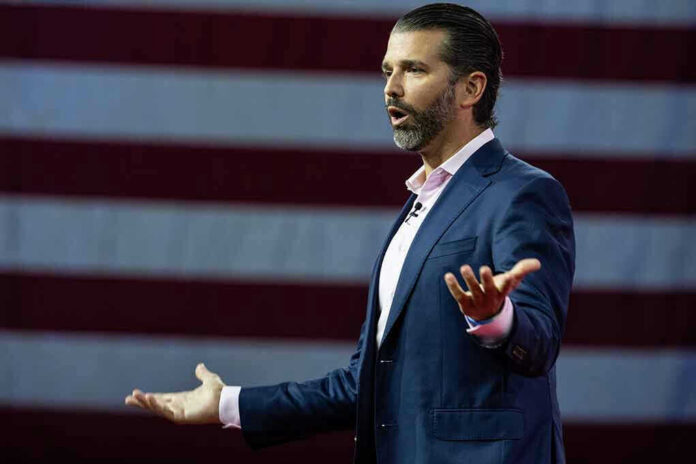
Kalshi’s push to let users bet with borrowed money lands as reports tie Donald Trump Jr. to a valuable equity stake and an adviser role at the CFTC-regulated platform.
Story Highlights
- Kalshi’s CEO confirmed Donald Trump Jr. is a company adviser on PBS, as ethics questions rise.
- Reports say Trump Jr. received about $300,000 in Kalshi equity when he joined in early 2025.
- Kalshi asked the Commodity Futures Trading Commission (CFTC) to allow borrowed-money bets, increasing risk.
- The company says it bans insider trading and bars officials from trading in markets they may influence.
Kalshi Confirms Trump Jr. Advisory Role Under Federal Oversight
Kalshi’s chief executive said on PBS that Donald Trump Jr. serves as an adviser to the company, which is regulated by the Commodity Futures Trading Commission. That on-air confirmation makes the relationship official and places it within a federal regulatory lane during President Trump’s administration. Kalshi publicly framed his input as strategic and growth-focused, not regulatory. Trump Jr.’s team has said he does not deal with the federal government for companies he advises, addressing key concern points raised by critics.
Reports from business outlets say Trump Jr. received roughly $300,000 in equity when he became a Kalshi adviser in early 2025, citing prior Financial Times reporting. Those stories add that the stake was granted when Kalshi’s value was under $2 billion, before rising sharply later, which increases the perceived value of his award on paper. The company has not posted grant documents publicly. The available record ties the dollar figure to reporting rather than a filed compensation agreement.
Borrowed-Money Bets Proposal Raises Risk and Optics Questions
Kalshi asked the Commodity Futures Trading Commission for approval to let some users trade with borrowed funds on event contracts. That would allow traders to post only part of the full cost to take positions, which can magnify gains and losses and force more collateral if markets move fast. The request arrives as the company faces questions about adviser ties and conflicts. The combined picture points to higher platform risk at the same time public concern about influence and access is growing.
Supporters of prediction markets say they improve forecasting and price real information. But leveraging bets can strain users and spread losses beyond what they planned. Senators have warned that margin on event contracts can expose people to outsized risks if regulators allow it, highlighting a consumer-protection angle distinct from normal investing. Kalshi’s filing reportedly targets qualified or institutional users, which may narrow the reach, but it does not erase the broader risk debate that leverage always sparks in markets.
Company Compliance Claims Meet Appearance-of-Conflict Concerns
Kalshi’s chief executive told PBS the company bans insider trading and bars members of Congress and administration figures from markets they could influence. Those rules are meant to curb abuse and protect trust. At the same time, the adviser relationship with Trump Jr. still raises appearance-of-conflict questions because Kalshi sits under the Commodity Futures Trading Commission’s oversight and prediction markets often trade on political outcomes. Ethics debates often focus on the look of access even when no rule is broken.
Coverage also notes Trump Jr. is linked to another prediction platform, Polymarket, as an investor and unpaid adviser, while serving as a paid adviser to Kalshi. That cross-industry role adds to claims of divided loyalties in a small market space. Trump Jr.’s spokesman has said he does not interface with the federal government for companies he advises, which, if accurate, draws a clear line between his business work and policy matters. No regulator has issued a finding that his role violates a specific rule at this time.
What Conservative Readers Should Watch Next
Conservatives care about clean rules, fair markets, and limited government power. This story blends all three. The Commodity Futures Trading Commission must weigh if borrowed-money bets on real-world events protect consumers and market integrity. Kalshi must show that its compliance policies are more than words and that adviser roles do not blur lines inside a federally regulated arena. Clear disclosure and tight recusal standards help win trust without inviting new federal overreach.
Kalshi hired Donald Trump Jr as a paid strategic advisor and gave him a $300k equity stake.
Kalshi is now asking the CFTC, part of Trump’s executive branch, to let people gamble more, with money they don’t have.
This is, by far, the most corrupt family in U.S. history. https://t.co/FBTcXo7maG
— Melanie D'Arrigo (@DarrigoMelanie) September 22, 2026
Here is the bottom line. The record confirms that Trump Jr. advises Kalshi and that outlets report a six-figure equity grant tied to his start date. The company is seeking permission to let some users trade on credit, which would raise risk on event contracts. There is no public evidence he lobbied regulators for Kalshi, and the company says it bars conflicted trading. Vigilant oversight and transparent rules can protect individual liberty, market innovation, and the public trust all at once.
Sources:
feedpress.me, pbs.org, ccn.com, nytimes.com, financefeeds.com, cryptopolitan.com, scu.edu