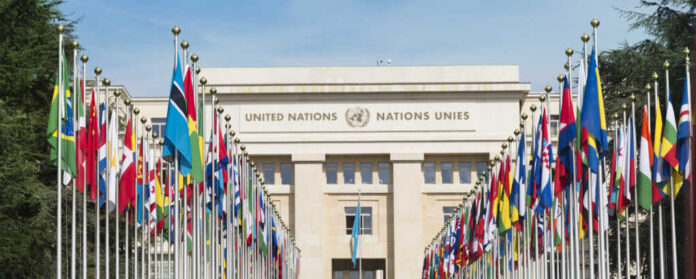
A top U.N. disarmament official is warning that the world is sliding back toward a nuclear age where miscalculation—not strategy—could decide humanity’s fate.
Story Snapshot
- U.N. disarmament chief Izumi Nakamitsu says “proliferation drivers” are accelerating as wars, threats, and distrust grow.
- The 2026 Nuclear Non-Proliferation Treaty (NPT) Review Conference is opening under pressure from renewed arms racing and fraying arms-control norms.
- Officials cite rapid technological change, including AI, as a factor that can amplify misunderstanding and decision-speed in crises.
- Roughly 12,500 nuclear warheads remain worldwide, underscoring why even small increases in risk can have outsized consequences.
NPT conference opens amid renewed nuclear pressure
United Nations disarmament chief Izumi Nakamitsu told reporters in New York that the forces pushing countries toward nuclear weapons are getting stronger, not weaker, as the 2026 NPT Review Conference gets underway. Her warning points to a global security picture marked by active wars, explicit nuclear threats, and widening distrust between nuclear “haves” and “have-nots.” When trust collapses, verification and restraint become harder, and the treaty framework meant to prevent new nuclear states becomes more difficult to sustain.
Nakamitsu’s message matters for Americans because U.S. security still rests on deterrence while Washington also depends on nonproliferation commitments to reduce the number of actors with nuclear capabilities. For conservative audiences skeptical of international bureaucracies, the core point is still concrete: every additional nuclear-armed state adds more launch authorities, more command-and-control systems, and more chances for error. Even critics of the U.N. can recognize that risk is a real-world, nonpartisan national-interest concern.
Arms-control erosion is reshaping incentives for new nuclear states
Nakamitsu emphasized that post–Cold War disarmament gains have been reversing, and she cited the demise of key guardrails as part of the broader shift. The research notes the Intermediate-Range Nuclear Forces (INF) Treaty as a notable example of an agreement that is now defunct, reinforcing the sense that old limits are falling away. When treaties fade and modernization accelerates, countries watching from the sidelines can conclude that nuclear weapons remain the ultimate security guarantor.
This trend also interacts with domestic politics inside many nations. If publics increasingly view nuclear weapons as the final insurance policy, leaders face pressure to match rivals rather than to bargain them down. The U.N. argument is essentially that narratives matter: the more nuclear weapons are treated as normal tools of statecraft, the harder it becomes to preserve a rules-based order. That is a challenge for both parties in the U.S., because it can multiply threats without a single shot fired.
AI and speed-of-war raise the danger of mistakes
Another element highlighted in the research is rapid technological change, including artificial intelligence, which officials say can increase the risk of miscalculation. The concern is not that AI “decides” to start a war, but that decision-makers may face faster-moving information environments where false signals, misread intentions, or automated analysis compress the time available to verify what is happening. In nuclear scenarios, minutes matter, and uncertainty can be deadly.
For Americans already frustrated with government competence, this is the uncomfortable overlap between high-tech ambition and bureaucratic reality. The more complex systems become, the more they rely on flawless communications, disciplined procedures, and leadership willing to slow down when the political incentives push toward escalation. The research also emphasizes accidental or mistaken use as a growing danger, a reminder that nuclear risk is not only about “bad actors,” but also about fallible institutions under stress.
What this means for U.S. interests in Trump’s second term
The U.S. approach in 2026 sits at a crossroads: maintain credible deterrence, modernize safely, and keep alliances stable while avoiding a world where more states join the nuclear club. Republicans who favor peace through strength will likely see modernization and readiness as essential, but the U.N. warnings underline a parallel duty: prevent uncontrolled proliferation that expands the number of nuclear decision points. Limiting the number of nuclear-armed states remains a practical way to reduce catastrophic risk.
BREAKING – UN chief warns 'drivers' of nuclear proliferation acceleratinghttps://t.co/1j2cRTJLDu
— Insider Paper (@TheInsiderPaper) April 27, 2026
The NPT Review Conference cannot guarantee success, and the research acknowledges uncertainty about outcomes after these remarks. Still, Nakamitsu’s core claim is a measurable warning sign: trust is low, arms-control structures are weaker, and technologies are speeding up crises. If Americans want a government that serves ordinary citizens instead of elite career incentives, nuclear policy is a place where competence, accountability, and clear doctrine matter—because the margin for error is effectively zero.
Sources:
UN chief warns ‘drivers’ of nuclear proliferation accelerating