
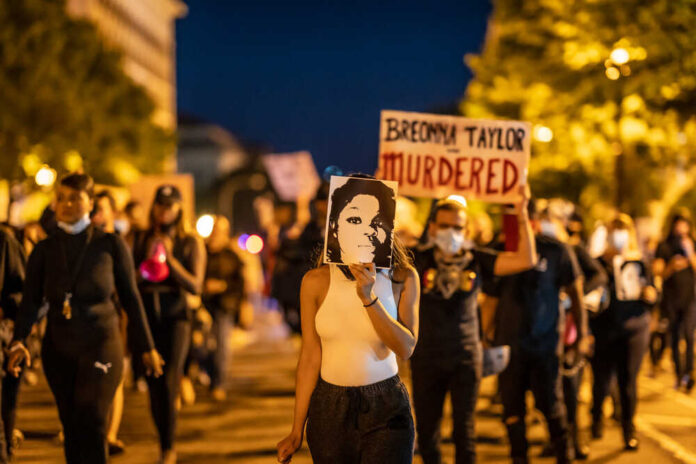
After years of headline-driven “justice” politics, the Trump DOJ is moving to drop federal charges in the Breonna Taylor raid case—forcing a hard look at what prosecutors can actually prove in court.
Quick Take
- Federal prosecutors asked a judge to dismiss charges against two former Louisville officers accused of falsifying information tied to the warrant used in the Breonna Taylor raid.
- The DOJ said dismissal is “in the interest of justice” after judges twice reduced the most serious felony counts to misdemeanors.
- A court hearing on the dismissal request is scheduled for April 3, 2026.
- The case highlights a major shift from Biden-era federal civil-rights prosecutions toward a narrower, evidence-driven posture under President Trump.
- Brett Hankison remains a separate legal track as the only officer who served time, with the DOJ also seeking his release pending appeal.
DOJ Moves to End a High-Profile Federal Case
Federal prosecutors on March 20, 2026, filed a motion to dismiss charges against former Louisville Metro Police Detective Joshua Jaynes and former Sgt. Kyle Meany. The men were accused of falsifying information connected to the search warrant that led officers to Breonna Taylor’s apartment during a March 13, 2020, no-knock raid. Prosecutors said the dismissal is “in the interest of justice,” with a hearing set for April 3.
The move follows a key legal problem for the government: judges had twice reduced the most serious felony allegations to misdemeanors, finding the case did not show a direct link between the alleged warrant falsification and Taylor’s death. That judicial narrowing matters because federal cases live or die on what can be proven beyond a reasonable doubt, not what makes for a compelling political narrative or a viral talking point.
What Happened in 2020—and Why It Still Matters
Louisville police executed the warrant at Taylor’s apartment while investigating a former boyfriend who no longer lived there. Taylor, a 26-year-old Black EMT, was killed during the chaos after her boyfriend fired at officers, believing intruders had broken in. The incident became a national symbol during 2020’s unrest and drove intense scrutiny of no-knock warrants, police tactics, and accountability. Louisville later agreed to a $12 million settlement with Taylor’s family.
Authorities reported no drugs or cash were found at the apartment, fueling public suspicion that the raid was built on shaky investigative work. But the federal case at issue was not a prosecution of the shooting itself. Instead, it focused on whether officers unlawfully used false statements to secure the warrant—an approach that the Biden DOJ embraced as a civil-rights angle when state-level cases did not bring charges for the fatal shooting.
Why Judges Downgraded the Charges
The government’s difficulty was not public outrage; it was causation and legal specificity. Judges twice reduced felony charges to misdemeanors after determining prosecutors did not establish a sufficient direct connection between the alleged falsified warrant information and Taylor’s death. That reduction undercut the leverage and the severity of the federal case, and it changed the risk calculus for prosecutors reviewing whether the remaining charges still served justice or merely prolonged a weak case.
Defense attorneys responded positively to the dismissal effort. Jaynes’ attorney said he was “elated,” while Meany’s attorney said he was “incredibly grateful” and emphasized his client’s desire to move on. For many Americans—especially those weary of politicized institutions—this is the point: equal justice means prosecutors should not stretch criminal law to satisfy public pressure when courts have already found the central theory too thin.
Competing Reactions: Family Anger vs. Prosecutorial Restraint
Breonna Taylor’s mother, Tamika Palmer, criticized the decision publicly, calling it “utterly disrespectful,” and family attorneys Ben Crump and Lonita Baker argued that accountability is being stripped away. Rep. Morgan McGarvey of Kentucky said, “This is not justice.” Those reactions reflect the broader reality that Taylor’s death remains emotionally and politically charged, especially after it became a rallying point for activists during the 2020 protest wave.
But prosecutors have a different job than activists and politicians. The DOJ’s stated reason—“in the interest of justice”—signals a conclusion that the remaining case, after repeated judicial reductions, may not meet the standard required for federal criminal punishment. The reporting available does not include independent expert analysis beyond stakeholders, so the public is left largely with courtroom rulings and partisan interpretations rather than neutral, outside evaluation.
The Separate Hankison Case and What Comes Next
The dismissal request for Jaynes and Meany is distinct from the case of former officer Brett Hankison, described as the only officer imprisoned in connection with the incident. Hankison received a sentence of two years and nine months for endangering neighbors after firing shots into windows, and that case is now on appeal, with the DOJ also seeking his release pending that appeal. Those separate proceedings add to public confusion but involve different legal theories.
The immediate next step is the April 3, 2026, hearing where a judge will consider the government’s motion to dismiss. Whatever the court decides, the episode illustrates a practical lesson conservatives have emphasized for years: when Washington chases outcomes instead of evidence, it fuels mistrust and politicizes law enforcement. A justice system that is restrained by facts and legal standards—rather than social media pressure—protects every citizen’s rights.
Sources:
Feds Move to Dismiss Charges Against Officers Accused of Falsifying Warrant in Breonna Taylor Raid
Federal prosecutors seek to dismiss charges against officers in Breonna Taylor’s killing
Federal prosecutors seek to dismiss charges against officers in Breonna Taylor’s killing