
President Trump’s vow to keep the Strait of Hormuz open—even for China—puts America’s military power and economic leverage on the line against Iran’s chokehold tactics.
Quick Take
- President Trump said the U.S. will work to keep shipping moving through the Strait of Hormuz and announced a $20 billion insurance program aimed at reviving commercial traffic.
- Iran’s Revolutionary Guard declared a blockade, and described shipping traffic as nearly halted, raising the risk of a global energy shock.
- Iranian strikes and interceptions across the Gulf were alongside confirmed U.S. service member deaths, signaling a widening regional war picture.
- China, heavily dependent on Gulf energy moving through Hormuz, pressed Tehran to avoid targeting tankers—while also deploying naval forces and exercising with Russia and Iran.
Trump’s Hormuz Pledge: Open Sea Lanes, No Exceptions
President Trump’s public commitment to keep the Strait of Hormuz open framed the waterway as a global commerce artery, not a bargaining chip for Tehran. Trump paired that message with a $20 billion insurance program designed to coax shippers back into the corridor after threats and attacks spiked risk premiums. The political headline is simple: Washington is signaling it will defend the principle of free navigation—even when that benefits competitors.
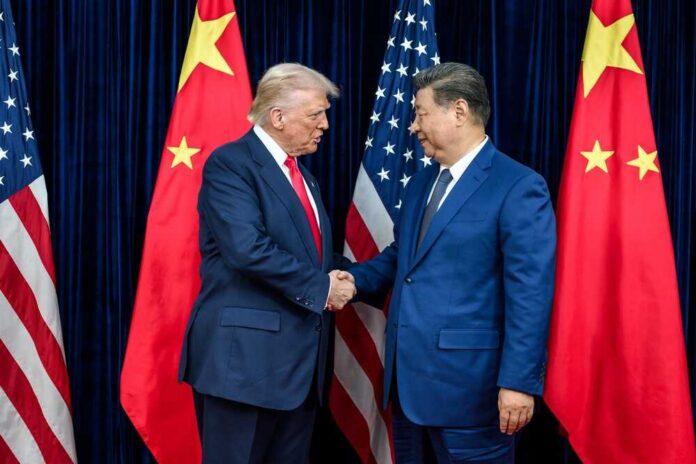
That “including China” line is what makes this moment different. China competes with the United States on trade, technology, and military reach, yet it also relies heavily on Persian Gulf energy. The current posture effectively tells Beijing: America won’t let Iran hold the world economy hostage, but the U.S. will still act in U.S. interests first—using naval power, economic tools, and alliances to keep critical chokepoints from becoming coercion points.
Iran’s Blockade Threat Collides With the Reality of Global Energy Dependence
The Strait of Hormuz remains a narrow maritime corridor with outsized impact because a major share of global oil consumption transits it. Reporting put the figure near 20%, a scale that turns any disruption into a worldwide price problem. As Iranian forces declared a blockade, accounts described shipping traffic as almost completely halted, with at least one tanker reportedly struck. Those conditions drive up insurance costs and can effectively stop trade even before a formal closure.
Energy disruption is not an abstract concern in a post-inflation decade. American families and retirees remember how quickly fuel and shipping costs can ripple into groceries and household staples. When a chokepoint event hits, consumers pay long before diplomats finish talking. It also described a dramatic hit to liquefied natural gas supply: Qatar reportedly halted production at Ras Laffan after an Iranian drone attack, an unusually severe step for a facility described as the world’s largest LNG export complex.
Military Escalation Across the Gulf Raises the Stakes for U.S. Deterrence
Regional strike-and-counterstrike reporting suggested the conflict is no longer limited to isolated incidents. Iran reportedly launched waves of missiles and drones at U.S. bases and regional targets. Gulf states were described intercepting incoming threats, including ballistic and cruise missiles, while debris and impacts were reported in civilian areas of Dubai and Abu Dhabi. U.S. Central Command reportedly confirmed that seven American service members were killed, a stark reminder that deterrence failures come with a human cost.
Former commander David Petraeus, described Iran’s attacks on Arab neighbors as a miscalculation—because hitting countries trying to avoid direct involvement can push them closer to U.S.-led defense efforts. That assessment matters for Americans evaluating risk: escalation can broaden the coalition against Tehran, but it can also widen the battlefield and increase the chance of mistakes. Either way, it increases pressure on Washington to back its Hormuz promise with credible capability.
China’s Energy Reality: Press Tehran, Deploy Forces, Avoid a Direct Clash
China’s posture in the crisis reflects a hard energy calculation. Research cited estimates that 45–50% of China’s crude imports transit Hormuz, with other reporting placing a large share of imports at risk when the corridor is disrupted. Chinese state-linked executives reportedly urged Iranian counterparts to avoid targeting oil and LNG tankers and to refrain from striking key export hubs. Chinese Foreign Minister Wang Yi reportedly told Tehran to heed neighbors’ “reasonable concerns,” signaling Beijing’s fear of regional blowback.
At the same time, China was described deploying naval forces to the region and participating in “Maritime Security Belt 2026” exercises with Iran and Russia—moves that complicate U.S. operations and increase the risk of miscalculation at sea. It does not fully detail the scale or composition of China’s deployment, so firm conclusions are limited. Still, the trend line is clear: Beijing wants the benefits of a secure sea lane without accepting U.S. dominance over it.
What Americans Should Watch Next: Insurance, Escorts, and the Cost of Weak Borders at Home
Trump’s insurance plan and the implied threat of naval escort operations are designed to restart traffic by reducing commercial risk and signaling U.S. resolve. The practical test will be whether shipping companies return in meaningful numbers while missiles fly and drones target infrastructure. U.S. and Israeli officials reportedly anticipated operations could continue for weeks, and analysts questioned how long Iran could sustain a war of attrition—especially because prolonged interference would also damage Iran’s own trade dependent on Hormuz-linked ports.
For conservatives, the larger takeaway is how global instability quickly becomes kitchen-table economics, and how deterrence abroad intersects with fiscal sanity at home. Protecting free navigation is a classic national-interest mission, but it must be executed with clear objectives and accountability. As this situation develops, Americans will want transparency on rules of engagement, the scope of any escort mission, and measurable benchmarks for reopening trade—without drifting into open-ended commitments.
Sources:
China bolsters naval presence in Strait of Hormuz amid US pressure on Iran and Venezuela
https://www.iranintl.com/en/202603036746
https://www.foxbusiness.com/video/6390644947112