

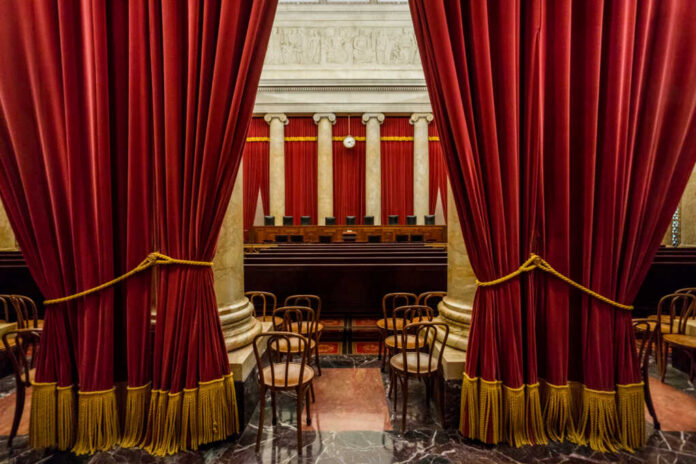
Justice Samuel Alito delivered a stinging rebuke to Justice Ketanji Brown Jackson, calling her accusations against the Supreme Court’s conservative majority “groundless and utterly irresponsible” in a rare public clash that exposes the deepening fractures within America’s highest court.
Story Snapshot
- Alito, joined by Justices Thomas and Gorsuch, issued a scathing concurrence criticizing Jackson’s solo dissent as “baseless and insulting”
- The dispute centers on fast-tracking a Louisiana redistricting ruling that eliminates a second majority-Black congressional district ahead of 2026 midterms
- Jackson stood alone in her dissent, with no other justices joining her objections to bypassing standard 32-day procedural timelines
- The decision potentially reshapes Louisiana’s congressional delegation from 5R-1D, strengthening Republican control before crucial midterm elections
Unprecedented Judicial Rebuke Over Redistricting Timeline
The Supreme Court issued an order on May 4, 2026, accelerating implementation of its April ruling that struck down Louisiana’s remedial congressional map as an unconstitutional racial gerrymander. Justice Alito’s concurrence, joined by Justices Gorsuch and Thomas, directly targeted Justice Jackson’s characterization of the expedited process as an “unprincipled use of power.” Alito demanded, “What principle has the Court violated?” The extraordinary public criticism highlights growing tensions within a court whose 6-3 conservative majority continues to reshape voting rights jurisprudence. Jackson’s isolation—standing completely alone without support from fellow liberal justices—underscores the stark ideological divide.
Voting Rights Act Interpretation Drives Core Conflict
The case originates from Callais v. Williamson, challenging Louisiana’s 2022 congressional map under Section 2 of the Voting Rights Act. Despite Black residents comprising approximately 33% of Louisiana’s population, the state’s map created only one majority-Black district out of six. Lower courts initially found this configuration discriminatory, ordering creation of a second majority-Black district. However, the Supreme Court’s conservative majority reversed course in April 2026, ruling 6-3 that the remedial map itself constituted impermissible racial gerrymandering. This decision continues the court’s pattern of narrowing Voting Rights Act protections, following landmark cases like Shelby County v. Holder (2013) and Brnovich v. DNC (2021).
Procedural Shortcut Sparks Constitutional Concerns
Jackson’s dissent focused on the Court’s decision to bypass Supreme Court Rule 45.3, which typically allows 32 days before rulings become final. The majority shortened this window to ensure Louisiana could redraw its congressional map before 2026 primary filing deadlines. Conservative legal scholars, including George Washington University law professor Jonathan Turley, defended the expedited timeline, noting that no party sought rehearing and that delaying implementation would force elections under a map the Court deemed unconstitutional. Critics from the left, however, view the acceleration as evidence of partisan maneuvering designed to benefit Republicans in upcoming midterms. This procedural battle reflects broader frustrations with a judiciary many Americans believe prioritizes political outcomes over consistent principles.
Electoral and Political Ramifications for 2026
Louisiana must now urgently finalize a new congressional map by summer 2026 to meet election deadlines. The redrawing will likely favor Republicans, potentially solidifying the state’s congressional delegation at five Republican seats and one Democratic seat. For approximately 1.8 million Black Louisianans, the ruling means reduced representation in Congress and diminished political influence. The decision carries national implications, setting precedent for similar redistricting challenges in states including Georgia and Mississippi. With Republicans controlling both chambers of Congress and the White House, this ruling strengthens the GOP’s electoral position heading into midterms, raising questions about whether judicial decisions increasingly align with partisan interests rather than impartial constitutional interpretation.
Deep State Concerns and Institutional Trust
The bitter exchange between Alito and Jackson feeds growing public skepticism about whether government institutions serve the American people or entrenched power structures. Conservative Americans see Jackson’s accusations as baseless attacks on justices faithfully interpreting the Constitution and protecting states from federal overreach. Liberal Americans view Alito’s aggressive response as evidence of a politicized court abandoning minority voting protections to entrench conservative power. Both perspectives reflect a shared concern: that unelected officials on the Supreme Court wield enormous influence over democratic processes with minimal accountability. The court’s decision to fast-track a ruling with major electoral consequences just months before midterm elections reinforces perceptions that Washington elites—whether in robes or suits—manipulate systems to maintain control rather than uphold founding principles of equal representation.
Sources:
The Supreme Court Just Made Its Voting Rights Ruling Take Effect Immediately – Public Notice