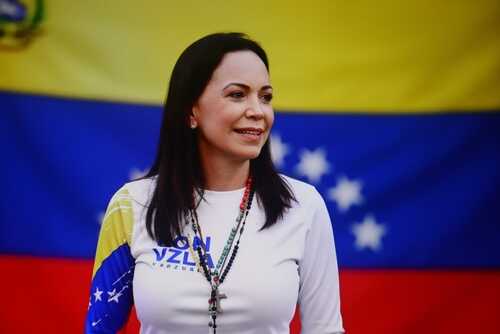
Venezuelan opposition leader María Corina Machado has put forth a bold initiative for democratic change across Venezuela, Cuba, and Nicaragua. This vision, supported by the Trump administration, seeks to dismantle long-standing authoritarian regimes, drawing a parallel to the historic fall of the Berlin Wall and signaling a major geopolitical realignment in the Americas.
Story Highlights
- María Corina Machado’s vision could end authoritarian regimes in Venezuela, Cuba, and Nicaragua.
- President Trump’s administration supports a democratic transition in Venezuela.
- Venezuela’s vast oil reserves are strategically significant for the U.S.
- Machado frames this potential shift as historically transformative.
Machado’s Vision for Democratic Change
Venezuelan opposition leader María Corina Machado has articulated a bold vision for democratic transformation across Venezuela, Cuba, and Nicaragua. This initiative, backed by the Trump administration, seeks to dismantle long-standing authoritarian regimes, echoing the historic geopolitical shift of the Berlin Wall’s fall. Machado’s meeting with President Trump underscores the U.S.’s renewed commitment to democratic values in the region.
The Trump administration’s support for Venezuela’s transition is a strategic move. Secretary of State Marco Rubio swiftly recognized Edmundo González as “Venezuela’s rightful president.” This decision highlights the administration’s focus on fostering democratic governance and aligning with conservative values. The U.S. sees an opportunity to reduce the influence of adversaries like China and Russia, who have used Venezuela as a foothold in the Americas.
Venezuelan opposition leader María Corina Machado, who was awarded the 2025 Nobel Peace Prize for her work in Venezuela, says Venezuelans thank President Trump and that "the freedom of Venezuela is near."
CBS News' @lilialuciano has more on Machado's response to the ouster of… pic.twitter.com/qXg0qvgEvt
— CBS News (@CBSNews) January 6, 2026
The Geopolitical Stakes
Venezuela, with its massive oil reserves, is a linchpin in the geopolitical puzzle. The Trump administration’s support for Machado aims to secure these resources, ensuring U.S. energy interests are protected. The administration argues that a democratic Venezuela would bolster regional stability and curtail the narco-state activities that have plagued neighboring countries.
Despite the complexity of dismantling authoritarian structures, the potential for a democratic shift in these nations holds promise for a realignment of power in the Western Hemisphere. Machado’s Nobel Peace Prize recognition further legitimizes her efforts and underscores the historic nature of this endeavor.
Implications for the Region
Machado’s vision extends beyond Venezuela, impacting Cuba and Nicaragua, both of which are aligned with the Venezuelan regime. The pressure on these nations to democratize could lead to significant changes in the region’s political landscape. The Trump administration’s policy shift is seen as a move to bolster American security and counteract the influence of adversarial regimes.
The transition is not without challenges. The immediate release of political prisoners is a critical step, yet the timeline for full democratic governance remains uncertain. The U.S. must remain committed to supporting Venezuela’s institutional transformation to ensure lasting stability and prosperity.
Watch the report: Venezuela is on the ‘threshold of freedom,’ María Corina Machado says
Sources:
Trump’s Meeting with Venezuela’s Nobel Laureate Machado Offers U.S. an Opportunity
Maria Corina Machado Press Conference
Machado says Venezuela is at ‘threshold of freedom’ – Multicultural Community
Machado says Venezuela has begun ‘transition to democracy’
Nobel Peace Prize Awarded to Maria Corina Machado from Venezuela